
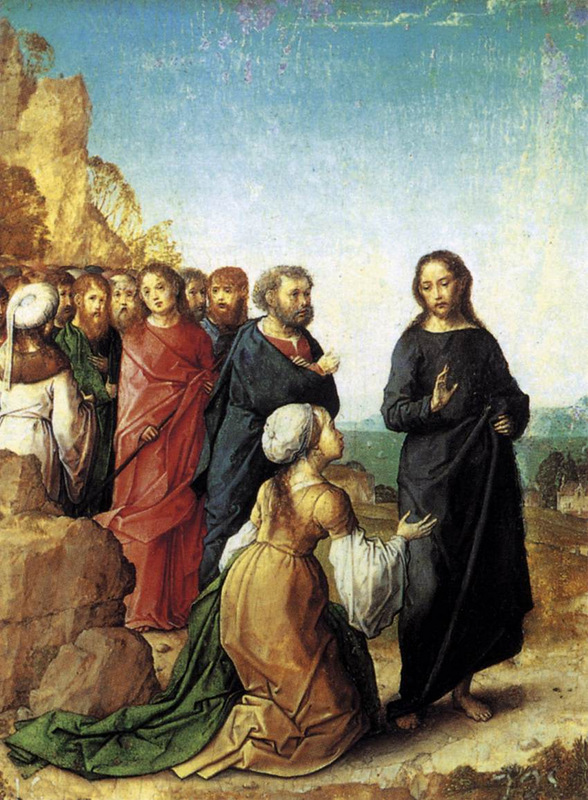
Juan, de Flandes, approximately 1465-1519. The Canaanite Woman asks for healing for her daughter, from Art in the Christian Tradition, a project of the Vanderbilt Divinity Library, Nashville, TN. https://diglib.library.vanderbilt.edu/act-imagelink.pl?RC=55921 [retrieved August 20, 2023]. Original source: http://commons.wikimedia.org/wiki/File:Juan_de_Flandes_-_Christ_and_the_Canaanite_Woman_-_WGA12050.jpg.
RCL Year A, Proper 15 (Alternate Readings)
Isaiah 56:1 and 6-8, Psalm 67, Romans 11:1-2a and 29-32, Saint Matthew 15:21-28
Once upon a time, I was part of a group where the ins were really in, and the outs were really out. Who is in, and who is out? The question arises when we read the Scriptures, and today it arises in all three lessons.
The trickiest passage is in Romans, but it is also the fullest expression of the question as well as the Christian answer to the question. As I read it to you, very kindly find it in your Service Leaflet. It is in the second half of the Epistle to the Romans.
“Just as you were once disobedient to God but have now received mercy because of their disobedience, so they have now been disobedient in order that, by the mercy shown to you, they too may now receive mercy.”[1]
Paul is addressing Christians at Rome who formerly were pagans. He says that the former pagans have received mercy, because God extended mercy to his chosen people, Israel, when they were disobedient. Since his chosen people received mercy when they disobeyed, so too do the pagans in Rome receive mercy after their disobedience.
Who is in, and who is out? Paul says that God shows mercy to disobedient Israel and to disobedient pagans. When both groups, Israel and the pagans, come to the knowledge of the one, true God, they are in. There are no outs when people come to God through repentance.
Isaiah strikes a similar note. Foreigners “who join themselves to the Lord”[2] are in. Joining themselves to the Lord means they will minister to the Lord, keep the sabbath, and undertake the other ways available to show their commitment. The Lord will gather the outcasts of Israel and others too. Nobody is out who doesn’t want to be out. Those who want to be in are in.
When we come to the Gospel, we see that the Canaanite woman, a foreigner, wants to be in. She knows Jesus is “Lord, Son of David,”[3] and she comes to him so that he can cure her daughter. And when Jesus seems to draw a line between her and “the lost sheep of the house of Israel,”[4] she just walks across that line, willing to be considered a dog, rather than a child, if that is what Jesus requires. To her testimony, Jesus exclaims, “Woman, great is your faith! Let it be done for you as you wish.”[5] She’s in, too. She wouldn’t take No for an answer.
Like Jacob, she wrestles with God. And for his wrestling, Jacob’s name was changed to Israel. And for her wrestling with God, she becomes part of the new Israel, the kingdom that includes all who wish to be God’s children, not just those who follow the old covenant. She receives the Lord’s blessing, as all do who wish to be joined to him.
Who is in, and who is out? The answer is: those who want to be. Those who want to be out, are out. And those who want to be in, are in. At every moment, we are at a point of decision.
[1] Romans 11:30-31.
[2] Isaiah 56:6.
[3] Saint Matthew 15:22.
[4] Saint Matthew 15:24.
[5] Saint Matthew 15:28.
 hs3rd
hs3rd 
