
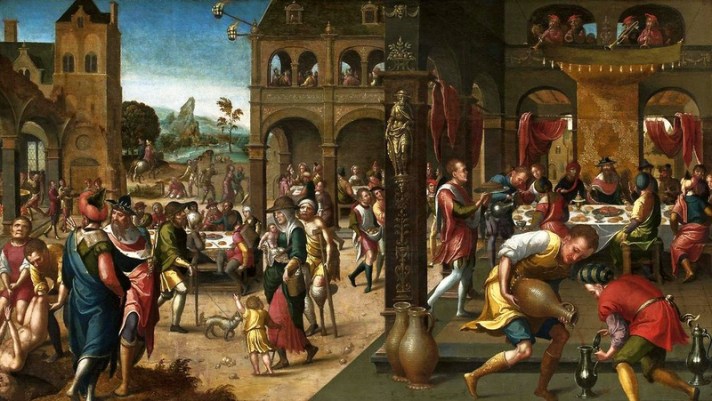
Brunswick Monogrammist. Parable of the Great Banquet, from Art in the Christian Tradition, a project of the Vanderbilt Divinity Library, Nashville, TN. https://diglib.library.vanderbilt.edu/act-imagelink.pl?RC=55984 [retrieved October 14, 2023]. Original source: http://commons.wikimedia.org/wiki/File:Brunswick_Monogrammist_Great_Banquet.jpg.
RCL Year A, Proper 23 (Alternate Readings)
Isaiah 25:1-9, Psalm 23, Philippians 4:1-9, Saint Matthew 22:1-14
Last week’s Parable of the Vineyard with Wicked Tenants put the chief priests and the Pharisees into a smoldering fury. They left the scene wanting to arrest Jesus, but they don’t do that. They leave him to tell another parable, the Parable of the Wedding Feast, a parable like the Vineyard and the Wicked Tenants. The Parable of the Wedding Feast, however, is directed toward Jesus’ true followers. I am taking that to mean that he speaks to you and to me, for we try to follow him to the best of our ability. And there is something he wants us to know, and that something is the word he gives us.
Both parables include the sending of two groups of slaves, the murders of those slaves, the punishment of the murderers, and the entrance of a new group into a privileged situation of which the former group had proved themselves unworthy. The former group is the chief priests and the Pharisees. The new group is we, you and I, who inherit from them the custody of God’s revelation of himself in Jesus Christ.
The wedding feast itself stands for the kingdom Jesus proclaims. That kingdom has two dimensions. Israel can enter it in the here and now, and the new church can enter it in eternity after having passed the final judgment. Israel has been judged, the chief priests and the Pharisees realize it, and the new church is being warned not to make the same mistake.
What mistake, what warning, is being given to the new church of Saint Matthew’s day? It turns on how we interpret the man not wearing a wedding robe. The man answers the invitation, but arrives improperly dressed. He enters but lacks full authenticity.
I take this to mean that he repented; he had the change of heart and disposition to do the right thing. But he lacks the proper garment; he wears not the life of good deeds, and he will suffer a fate like those who rejected God in ages past.
You remember how Jesus said, “Not everyone who says to me, ‘Lord, Lord,’ will enter the kingdom of heaven, but only the one who does the will of my Father in heaven.”[1] He heard the call. The man not wearing a wedding robe said “Lord, Lord,” but he fails to do the will of the Father in heaven. There is more that he can do.
There is more we all can do. This time of year, we hear about “time, talent, and treasure.” There isn’t anyone here who is maxed out in all three areas. Each one of us has more time, more talent, and more treasure. We could give it away, and be in line to receive it in return tenfold. That’s the way it works. God made the world in such a way that that is the way it works. Saint Luke in Acts quotes Jesus as having said, “It is more blessed to give than to receive.”[2] I believe that’s true. It’s just as true as the last verse in today’s Epistle, when Saint Paul writes, “Keep on doing the things that you have learned and received and heard and seen in me, and the God of peace will be with you.”[3]
[1] Saint Matthew 7:21.
[2] Acts 20:25.
[3] Philippians 4:9.
 hs3rd
hs3rd 
