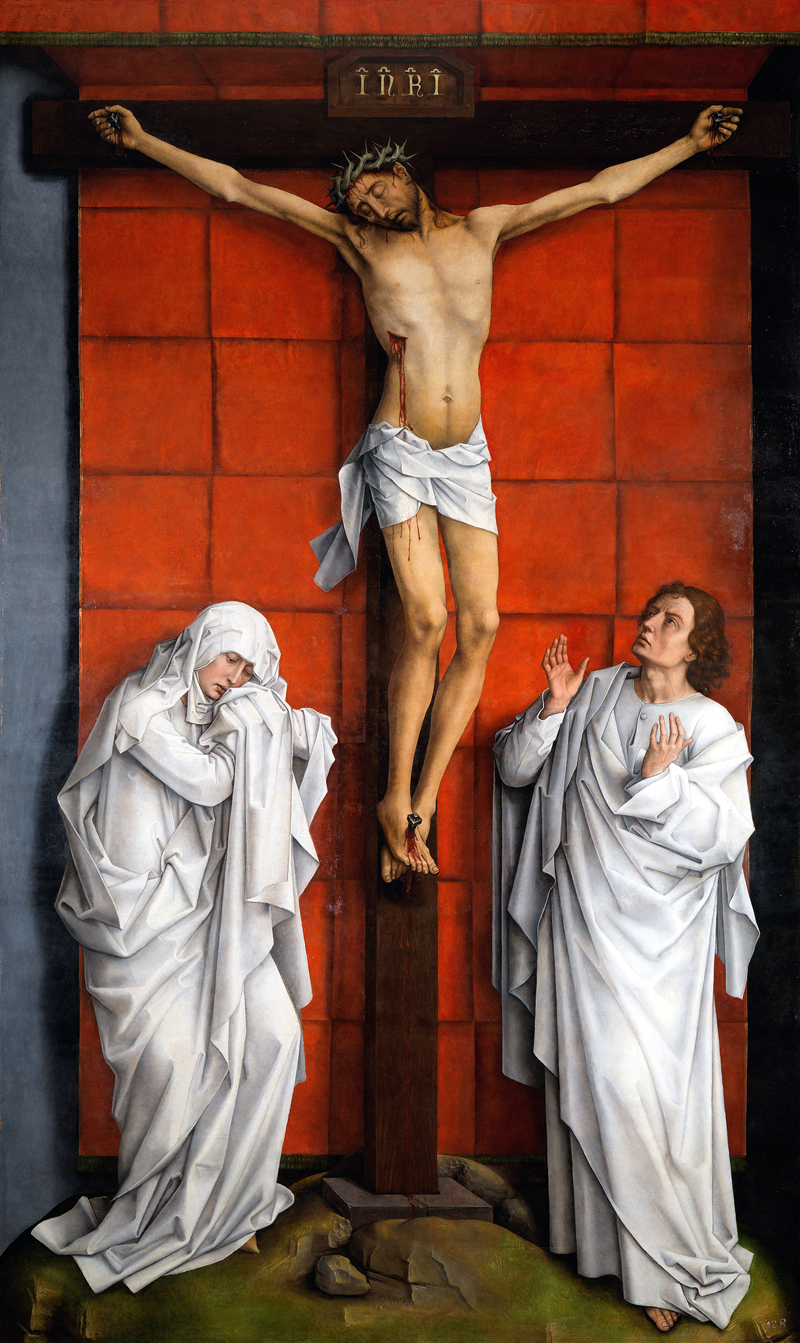
Weyden, Rogier van der, 1399 or 1400-1464. Christ on the Cross with Mary and John, from Art in the Christian Tradition, a project of the Vanderbilt Divinity Library, Nashville, TN. https://diglib.library.vanderbilt.edu/act-imagelink.pl?RC=57343 [retrieved April 20, 2024]. Original source: https://commons.wikimedia.org/wiki/File:Weyden_Christ_on_the_Cross_with_Mary_and_St_John.jpg.
RCL Good Friday
Isaiah 52:13—53:12, Psalm 22, Hebrews 10:16-25, Saint John 18:1—19:42
“They shall look on him whom they pierced.”[1] With what vision will they see him? If we are among those who pierced him, how will we understand what we see?
With the disciples, we easily recall that the Lord had said that he would “be rejected by the elders, the chief priests, and the scribes, and be killed, and after three days rise again.”[2] If those religious leaders are among those who pierced him, how would they understand him, hanging and dying on the tree? The religious authorities were confronted by this man who went out of his way to welcome outsiders and people who were not like them, people who didn’t follow the religious rules terribly well. Those religious leaders could not help but see him whom they had pierced as a dangerous man who would have brought about violence upon their own people whom they needed to protect by handing him over to a violence that they could summon from the occupying colonial power. Those leaders told the Romans that he was dangerous. They would have said, speaking to themselves, and anyone who would listen, that he had transgressed the boundaries we have, the boundaries we have from God that keep us safe from sin. He was always letting unclean people near him. He was reckless in giving and forgiving, and these feedings, these healings, and these raisings from the dead, give people false hope—he must be made quiet so that people will learn the right way, the right way to come to God. It’s very simple—when we are good then God will love us. And, when we are bad, God punishes us—that is the order of things. Jesus, those leaders would have said, looking at him whom they had pierced, makes people think too much about God anyway. They probably should be thinking much more about their own sinfulness, about how much harder they should try to live up to the law and to be good. And, anyway, he seduces the people into hoping for something from God which they could not possibly have deserved. And, beyond all this, he says he is God’s own beloved Son. We must do away with him.
And, the Romans, the occupying, colonial power, how would they have looked upon him whom they pierced? The Romans used crucifixion as a tool, an instrument of violence to dominate and to terrorize subject populations all over the Mediterranean world, stringing up live human beings on wooden beams dozens and dozens upon crosses across hillsides attempting to terrify people into submission. In a world like that, which the Romans had subjugated and brought to its knees, the Romans themselves would have found it hard to see God at work in anything. The Roma way was the only thing at work any where in the known world. Anyone who attracted sufficient attention to be strung up was a threat removed, a squeaky wheel silenced. They would look on him whom they had pierced as a piece of work in a workaday world, the ironing out of a wrinkle who would never again cause any problem.
We must ask, as we look on, what Mary and the Beloved Disciple, who risked everything to be near to him, understood when they looked on his agony. They must have asked God for the vision to show them the deeper meaning of what her son and his friend was undergoing. They knew he loved his own who are in the world. And they saw him love them to the end.
And how do we see him? We can see in his dying breath followed by his resurrection God’s life, God’s all-powerful life, the creative force that summoned and sustains the universe into being. Do you think a little death can stand in the way of that powerful life, the life that brought into existence the galaxies, the planets, and the stars, and every blade of grass, held continually in existence by the song of the Greatest Singer of life, the almighty and the everlasting God? That life, that creating and sustaining power, that is the life that we meet in the risen Christ. The resurrection of Christ is the future of the universe breaking into our present world through a tomb, of all things. And, furthermore, this way of seeing the cross of Jesus and what it means is only possible because of his being alive to teach us now and to work his new life within our minds and hearts. And so it was for Jesus’ first disciples. And so it can be for us now if we ask Jesus crucified and yet alive to take his friends by the hand just as now at this very time in this very liturgy, he may come to us by the power of the Spirit and lead us into the very heart and meaning of all that he does and all that he suffers in order that we in him can go on loving where we, without him, would turn away. In him, we choose to go on loving and embrace every moment of his life in our earthly life, the moments that we have forgotten that he was with us and will be with us. He very likely will tell us that all his Father ever wanted was to love us and love us into loving him in return. It is enough if we but look on him and love him. Amen.
[1] Saint John 19:37. Douay-Rheims Bible.
[2] Saint Mark 8:31.
 hs3rd
hs3rd 

You must be logged in to post a comment.