
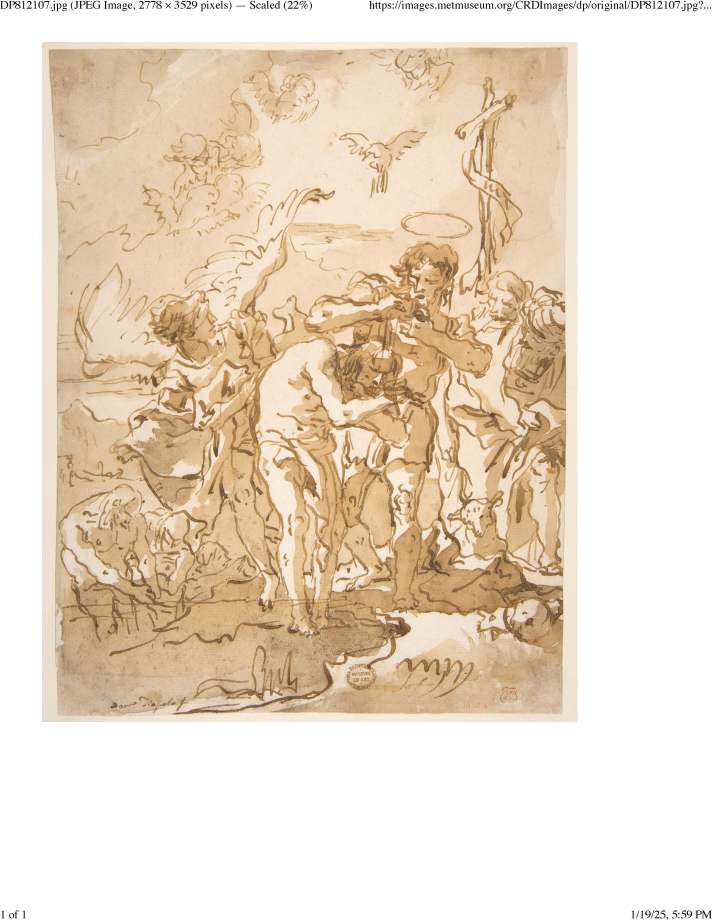
The Metropolitan Museum of Art, New York City. Giovanni Domenico Tiepolo, “The Baptism of Christ.” Venice, 1727-1804. OA, Public Domain.
RCL Year C, Epiphany 1
Isaiah 43:1-7, Psalm 29, Acts 8:14-17, Saint Luke 3:15-17 and 21-22
The Lesson today from Acts is of especial interest to Episcopalians, particularly those who join this church having been baptized in another church.
The reading is of especial interest because of the circumstance of those Samaritans: they have been Baptized in the name of the Lord Jesus, only, and they have not yet received the Holy Spirit by the laying on of hands of the apostles. The Lesson explores, and suggests a resolution to infant Baptism in Confirmation. Confirmation, in the Episcopal Church, offers the opportunity to those baptized as infants to make a mature, and adult, profession of faith that they could not make as infants. This mature, adult, profession was important to the Reformers in sixteenth-century England, for, without it, adults had not the opportunity to profess their faith and to take their own responsibility for the promises made for them by their parents and godparents when they were infants.
All of which brings me to the Baptism of the Lord Jesus at the hands of John the Baptist that is the subject of today and today’s Gospel. John’s baptism of Jesus raises again, as it always does, the question why Jesus undergoes it. We can always say that Jesus does it to “fulfill all righteousness.” And today I want to specify a particular meaning of fulfilling all righteousness.
There is a sacramental principle that God calls us to do something simple, and God meets us there. We respond to God’s call to meet him, and he meets us. We do something simple and ordinary and physical, and we meet him there. That is why Jesus undergoes John’s baptism. He does something simple and ordinary and physical to answer God’s call to be in word and deed God’s Son. The outcome you heard in the Gospel. After the baptism, the Holy Spirit descends and the heavenly voice declares, “You are my Son, the Beloved; with you I am well pleased.”[1]
And so it is with us. In the Eucharist, and in Baptism, and in Confirmation, as in any of the sacraments, we respond to God, and we should respond with an intention of our will. We respond by making a choice. You should do this every time you receive Holy Communion. You should do this today, and I give you an intention to use if you like. When you receive Holy Communion, declare to God that you intend to respond to God’s will and God’s plan for you in every circumstance in your lives. For that is what Jesus does when he receives John’s baptism. And if you declare this intention, and keep it, God’s light will become your light, and your life will be light to all of those around you.
“Let your light shine before others, so that they may see your good works and give glory to your Father in heaven.”[2]
[1] Saint Luke 3:22.
[2] Saint Matthew 5:16.
 hs3rd
hs3rd 
You must be logged in to post a comment.