
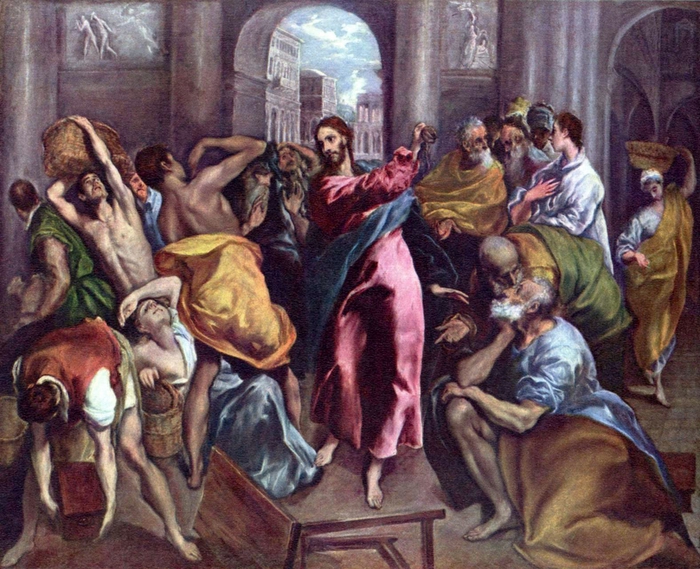
Greco, 1541?-1614. Christ Expelling the Money Changers in the Temple, from Art in the Christian Tradition, a project of the Vanderbilt Divinity Library, Nashville, TN. https://diglib.library.vanderbilt.edu/act-imagelink.pl?RC=48047 [retrieved March 2, 2024]. Original source: https://commons.wikimedia.org/wiki/File:El_Greco_Christ_Driving_the_Money_Changers_from_the_Temple.jpg.
RCL Year B, Lent 3
Exodus 20:1-17; Psalm 19; 1 Corinthians 1:18-25; Saint John 2:13-22
Before I begin the homily itself, I want to say a word about the Gospel which is John’s account of Jesus cleansing the Temple. The cleansing of the Temple occurs in all four Gospels. In John, it occurs early in Jesus’ ministry, and, indeed, today we are in Chapter 2 of John. In the synoptic Gospels—Matthew, Mark, and Luke—the cleansing occurs between Jesus’ triumphal entry into Jerusalem on Palm Sunday and his Passion. Some scholars write that the cleansing in the synoptic Gospels is a major trigger in bringing about Jesus’ Crucifixion.
But the cleansing from the synoptic Gospels is not included in our Lectionary, which we share with Roman Catholics, Lutherans, and Methodists. We never have the synoptics’ account of the cleansing in our services. Only John’s account is included in our Lectionary, and that inclusion occurs only on today, the Third Sunday in Lent in Year B. I have pondered this matter for years, and have read what I can about it, and I yearn to be given a deeper understanding about the cleansing of the Temple and its place in Jesus’ earthly ministry.
Over coffee, I would be happy to entertain any questions about this that you may have. Now for the homily for today.
“Who can tell how often he offends? * cleanse me from my secret faults.”[1] The offenses of which we are not even aware—they, too, are forgiven by a loving and merciful God. They, too, are put to flight by the glory of the cross.
A Roman Catholic came to see me once, and he said that one of the things attracting him to the Episcopal Church is the General Confession—“It’s all out in the open,” he said, “nothing hidden away.” I tried to tell him that the theology of our church and his about the forgiveness of sins is exactly the same: those sins that are truly repented are truly forgiven. We use the General Confession as a way to garner all of our sins, known and unknown, and through an act of the will to repent them and to be forgiven them.
But, as Saint Paul says, there’s an even more excellent way. If you wish to receive forgiveness, forgive someone who needs your forgiveness. It’s ironic, I know, but so is the irony that the first will be last and the irony that it is in dying that we live. Christianity is that way. As we forgive, so will we be forgiven.
Christ overturned a lot when the tables went headlong in the temple. And in our own lives Christ can find much meriting his righteous anger: our pride and hypocrisy, as well as our secret and unknown offences. But certainly needing overturning is our quickness to take his forgiveness while withholding our forgiveness from those who need it and who expect us, as Christians should, quickly to forgive.
Make it a point before Easter to share Christ’s forgiveness. I don’t mean share as in “take.” I mean share as in “give.” You have received Christ’s forgiveness—Christ forgives the sins we truly repent. Share that forgiveness with someone who needs your forgiveness, your blessing. No harm will come of it. If it hurts, it’s only your pride that hurts. Your heart will grow stronger, and God’s message of pardon and mercy will be proclaimed and heard.
[1] Psalm 19:12.
 hs3rd
hs3rd 

You must be logged in to post a comment.