
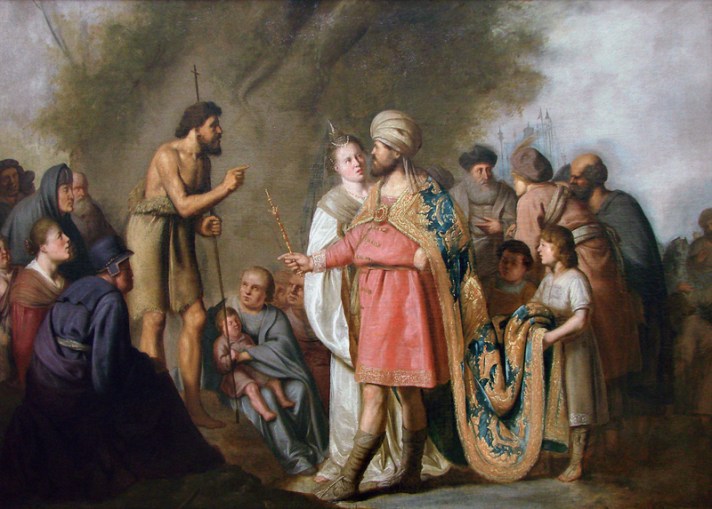
Grebber, Pieter de, approximately 1600-1652 or 1653. Jean the Baptist Preaching Before Herod, from Art in the Christian Tradition, a project of the Vanderbilt Divinity Library, Nashville, TN. https://diglib.library.vanderbilt.edu/act-imagelink.pl?RC=57971 [retrieved July 14, 2024]. Original source: https://commons.wikimedia.org/wiki/File:Mus%C3%A9e_de_Lille_P._F._de_Grebber.jpg.
RCL Year B, Proper 10 (Alternate Readings)
Amos 7:7-15, Psalm 85:8-13, Ephesians 1:3-14, Saint Mark 6:14-29
We cannot healthily turn a blind eye toward the violence yesterday in Butler, Pennsylvania. Nor can we put our heads into the ground as if it did not happen. For the humanity given to us by God Christ came to redeem. This same humanity we share with both the perpetrator and the victims.
I pray that we can find it within ourselves to pray for all of them as well as for our country, remembering the words of Christ our Savior: “Amen I say to you, there hath not risen among them born of women a greater than John the Baptist: yet he that is lesser in the kingdom of heaven is greater than he. And from the days of John the Baptist until now, the kingdom of heaven suffereth violence, and the violent bear it away.”[1]
It is enough to remember that violence yesterday and forever God permits with our sinfulness, but it is abhorrent to God’s perfect will.
The readings today from Amos and Mark are quite challenging. The best approach is to see Amos, to see John the Baptist, and to see Jesus as God’s loyal agents who speak for God and who speak against the political and religious leaders of their day.
Each one of them follows Balaam’s Rule. As Balaam said to Balak, “Must I not take care to say what the Lord puts into my mouth?”[2] Amos, John, and Jesus each take care “to say what the Lord puts into [his] mouth.”
Were you to read the short book of Amos, you would see how fearless he is in his prophecies: he prophesies the overthrow of the sanctuary at Bethel, the fall of the royal house in Israel, and the captivity of the people. He was not out to make friends; he was out to prophesy what the Lord God showed him to be true.
Amos’ willingness to take on the religious and royal hierarchies finds a parallel in John the Baptist. John knows and points out that Herod and Herodias have an adulterous affair while Herodias and Philip are married. In time, Herodias divorces Philip and marries Herod. John declares to Herod, “It is not lawful for you to have your brother’s wife.”[3]
As a result of their prophecies, as a result of what the Lord has put in their mouths, Amos is cast out of the shrine at Bethel, John is beheaded, and Jesus is crucified. God permits the violent to bear the kingdom away for a short time. But, as you know, their stories do not end there. God has the last word. Amos’ prophecies are realized, and the exiles return to Israel from Babylon. John’s prophecies, also, are realized when the Romans come to Jerusalem to subjugate Israel completely and, leaving no doubt as to who is in charge, to destroy the Temple. And, finally, Jesus’ prophecies, also, are realized when he rises from the dead and his followers begin a movement that overwhelms Judaism and eventually the Roman Empire.
In the end, God has the last word. God always has the last word. Any victory and any defeat we experience is subject to divine review and revision.
God’s true followers always follow Balaam’s Rule: “Must I not take care to say what the Lord puts into my mouth.” In the end, in God’s end, human will, when opposed to God, can slow, but it cannot frustrate, the providential design of a loving God. Never forget: he’s got the whole world in his hands.
[1] Saint Matthew 11:11-12. Douay-Rheims Bible.
[2] Numbers 23:12.
[3] Saint Mark 6:18.
 hs3rd
hs3rd 

You must be logged in to post a comment.