
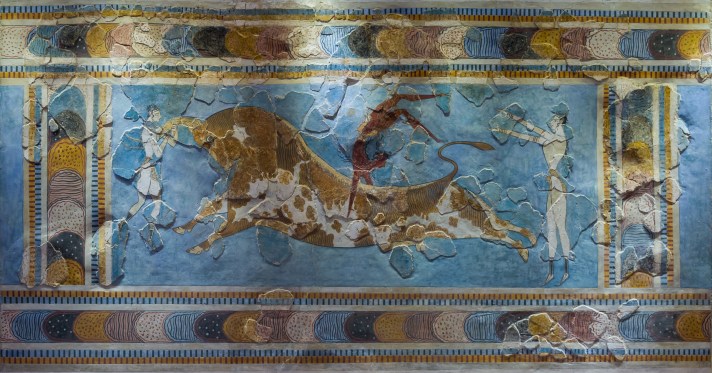
Heraklion Archaeological Museum, CC0, via Wikimedia Commons
RCL Year A, Proper 7 (Alternate Readings)
Jeremiah 20:7-13, Psalm 69:8-11 and 18-20, Romans 6:1b-11, Saint Matthew 10:24-39
There are many, many works of art from ancient Crete depicting men leaping over charging bulls. The Lessons today reminded me of them, for the reading from Jeremiah and the Gospel are like the horns of a bull charging each one of us. How likely is it that any one of us will be able to grab both horns of the bull and somersault successfully over the raging animal to safety? How likely is that?
If you have ever played golf during your parish’s single weekly Eucharist, your sure and certain opportunity to give thanks to God; if you have ever failed to mention when opportunity arose, that Jesus is your Lord and Savior; if you have ever said No to any sincere cry for help from the least of those on the earth; then that bull bears down on you; then you are with Jeremiah when he likens his refusal to fulfill the office of a prophet to enduring “something like a burning fire shut up in [his] bones.”[1] If you have ever left a cross at your feet, rather than taking it up and following Jesus, then you are not worthy of him. Somersaulting that bull is harder than the skillful make it seem. It is harder than the ancient artists have depicted it.
Where, O where is the good news in this? The good news is hard to find within the confines of the few verses from Jeremiah and Saint Matthew. Saint Paul, however, opens the door to good news in the Epistle when he asks, “Do you not know that all of us who have been baptized into Christ Jesus were baptized into his death?”[2] But even here, the good news lies behind an intimidating prospect. To live in Christ, we must first die in Christ. Dying in Christ leads to living in Christ for ever.
The good news is there eventually and ultimately, after we have endured what we have to endure to get there. Jeremiah has to endure the people around him saying, “Terror is all around! Denounce him!”[3] Their clamors are part of what it means to be a prophet for the Lord. He simply has to endure them; he simply has to transcend them. To transcend them, he becomes what the Lord called him to be—a calling this Lesson calls an “enticement.” One translation I saw begins this way, “You duped me, O Lord, and I let myself be duped.”[4]
Similarly, the followers of Jesus will have to endure his promise to bring a sword rather than peace. They will have to endure being set against mother or father; they will have to acknowledge him in front of detractors in order for him to acknowledge them before his Father in heaven. But as they, as we, do these things they and we are to know that the hairs of our heads have been counted; we are precious in his sight.
The Lessons today have been selected to remind us that our lives are complicated by the charging of many bulls. There is no avoiding the uncomfortable truth that our calling, yours and mine, is to stand for God. Single-mindedly, we are to stand for God. God expects it. He has witnessed through the Scriptures that those bulls are coming after us. And to be his, we will have to seize the opportunity to grab a pair of horns and vault over the ferocious animal. And when we do that, when we answer our calling, he will be with us. He will keep us his. We shall be his in that moment and for ever.
[1] Jeremiah 20:9.
[2] Romans 6:3.
[3] Jeremiah 20:10.
[4] Jeremiah 20:7. The New American Bible (New York: Catholic Book Publishing Corporation, 1970).
 hs3rd
hs3rd 