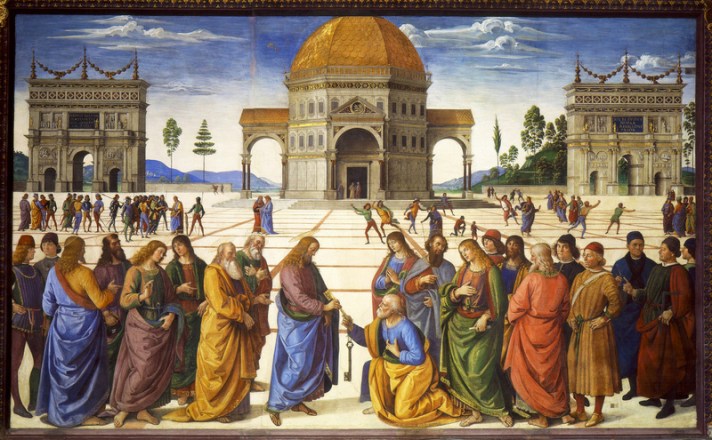
Perugino, approximately 1450-1523. Christ gives the keys of the kingdom to Peter, detail, from Art in the Christian Tradition, a project of the Vanderbilt Divinity Library, Nashville, TN. https://diglib.library.vanderbilt.edu/act-imagelink.pl?RC=55925 [retrieved August 26, 2023]. Original source: http://commons.wikimedia.org/wiki/File:Entrega_de_las_llaves_a_San_Pedro_(Perugino).jpg.
RCL Year A, Proper 16 (Alternate Readings)
Isaiah 51:1-6, Psalm 138, Romans 12:1-8, Saint Matthew 16:13-20
I have noticed in the past few days a coolness in the air. Summer bends toward autumn. Falling leaves and football lurk around a very near corner. The year approaches an inflection, a turning to something else, to something different.
That turning in the year and in the weather has a parallel in the Gospel. Today’s Gospel begins that turning. We have the Confession of Saint Peter, as it is called. Peter has seen up close the early ministry of Jesus—his teaching and his healing miracles—and, when Jesus asks him whom people say Jesus is, Peter then says that Jesus is “the Messiah, the Son of the living God.”[1]
Peter’s Confession, then, represents the meaning Peter has made of the experience of following Jesus. Soon after it, Jesus predicts his passion and resurrection for the first time. And after that, Jesus is transfigured, before additional predictions from Jesus about his passion and resurrection. The inflection point links Jesus the teacher with Jesus the sacrificial victim for the sins of the whole world.
The Confession of Peter is a similar turning point also in Saint Mark[2] and in Saint Luke[3]. In those accounts, however, Peter speaks for the other disciples. In Saint Matthew, on the other hand, Peter has been given a special revelation the other disciples have not received.
“Jesus answered him, ‘Blessed are you Simon son of Jonah! For flesh and blood has not revealed this to you, but my Father in heaven. And I tell you, you are Peter, and on this rock I will build my church, and the gates of Hades will not prevail against it.’”[4] The Confession of Saint Peter that Jesus is both Messiah and the Son of the living God Jesus attributes to a divine revelation to Peter alone, and this revelation makes him the rock on which Jesus will build his church.
In the First Lesson, we heard the Lord, speaking through his prophet, say that “my salvation will be forever, and my deliverance will never be ended.”[5] Regardless of Peter’s standing above or among the disciples, the standard for our belief and our fidelity is to believe and to see the Lord’s unending salvation and deliverance in what Jesus was about to do. His passion and resurrection deliver us from exile and from sin and death. And Peter, speaking for us or to us, emphasizes the association of the teacher and healer to the sacrificial victim. Jesus’ resurrection is our salvation forever and our deliverance unending.
I hope that you can see that Jesus as teacher and healer could never become our salvation and our deliverance. Peter’s Confession connects the teacher and healer with the sacrificial lamb. As the weather moderates, as we brace for the cold and the ice, we move into a more demanding area of Jesus’ ministry—an area in which he asks us to accept his sacrifice, an area in which he asks us to accept him as our Savior.
[1] Saint Matthew 16:16.
[2] Saint Mark 8:27-29.
[3] Saint Luke 9:18-20.
[4] Saint Matthew 16:17-18.
[5] Isaiah 51:6.
 hs3rd
hs3rd 
.jpg)