
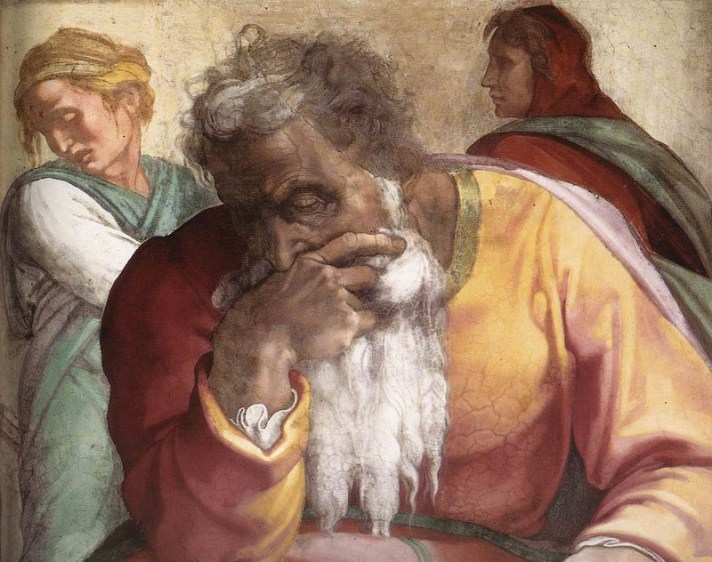
Michelangelo Buonarroti, 1475-1564. Jeremiah, from Art in the Christian Tradition, a project of the Vanderbilt Divinity Library, Nashville, TN. https://diglib.library.vanderbilt.edu/act-imagelink.pl?RC=55963 [retrieved September 2, 2023]. Original source: http://commons.wikimedia.org/wiki/File:Michelangelo,_profeti,_Jeremiah_02.jpg.
RCL Year A, Proper 17 (Alternate Readings)
Jeremiah 15:15-21, Psalm 26:1-8, Romans 12:9-21, Saint Matthew 16:21-28
Words of the Lord to the prophet Jeremiah: “I will deliver you out of the hand of the wicked, and redeem you from the grasp of the ruthless.”[1]
I plan to ask you to apply this prophecy to three different people. The result I call a three-story idea. First, apply this prophecy to Jeremiah. He warned the people of Judah against Babylon, and, like the people of Judah under the king Zedekiah, he sided with Egypt in its conflict with Babylon for world rule. After the Babylonians destroyed the Temple and deported exiles from Jerusalem to Babylon in 586 bc, Jeremiah was left free to live in Judah. The Jews forced him to go with them to Egypt where he reproached them for their worship of idols. The Scriptures contain no record of his death. The Lord delivered him from the wicked and redeemed him from the ruthless.
Now, if you will, apply that prophecy to Jesus. Jesus, indeed, as he predicts in the Gospel, undergoes great suffering and death, but through his resurrection, he is delivered from the hand of the wicked and redeemed from the grasp of the ruthless.
And, finally, I ask you to apply Jeremiah’s prophecy to yourself. For we believe in the resurrection of the dead, as we profess in the Creeds. Our deliverance and our redemption lie before us. We believe they are ours as we believe that we are Christ’s. Jeremiah’s prophecy applies to us all.
Taking a small slice of the Scriptures and applying it, in turn, to its original application, then to Jesus, and then to the early and later Christians, endures to be the most helpful and traditional way to understand God, the world, and ourselves. Every aspect of the Scriptures, of our liturgy, and our own quest for understanding draw us in to be part of the perception that God made everything that is and that “we are the people of his pasture and the sheep of his hand.”[2]
The dots are not always easy to connect, and certainty is hard to find. But in the end, the meaning we make from the Scriptures, the liturgy, and our experience, however wide, bring us to strength and hope. Darkness has not extinguished light, and evil never captures Jeremiah or Jesus, or anyone who trusts in God. “Lord, I love the house in which you dwell * and the place where your glory abides.”[3]
[1] Jeremiah 15:21.
[2] Psalm 95:7.
[3] Psalm 26:8.
 hs3rd
hs3rd 
