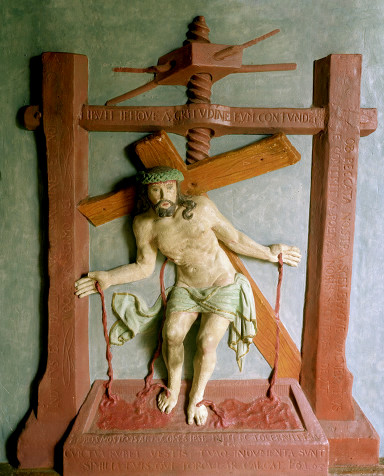
Anonymous. Jesus in the wine press, from Art in the Christian Tradition, a project of the Vanderbilt Divinity Library, Nashville, TN. https://diglib.library.vanderbilt.edu/act-imagelink.pl?RC=55728 [retrieved October 8, 2023]. Original source: http://www.brunoglint.com/#/my-bataille/4567580253.
RCL Year A, Proper 22 (Alternate Readings)
Isaiah 5:1-7, Psalm 80:7-14, Philippians 3:4b-14, Saint Matthew 21:33-46
The Scriptures today give us two vineyards, and they are similar in several respects, but they are different in other respects. The similarities and the differences instruct us about the way we should direct our footsteps to move forward toward God’s good pleasure.
Let’s begin with the vineyard in Isaiah. The vineyard has most everything a vineyard needs. It has fertile soil. The fertile soil is cleared of stones. The fertile soil has been planted with choice vines. The vineyard has a watchtower and a wine vat. But, there’s always a but, it yields not grapes but wild grapes, grapes which cannot become drinkable wine. It has everything, but it fails to achieve its purpose.
And now, let’s turn to the vineyard in Jesus’ parable. It, too, is planted, and has a watchtower and a wine press if not a wine vat. But, there’s a but here too, the tenants who lease it decide to keep the grapes for themselves. They do not keep the agreement of the lease. Instead of returning the grapes to the owner, the tenants, the franchisees, keep the grapes for themselves.
So, Isaiah’s vineyard fails to achieve its purpose by producing wild grapes, and Jesus’ vineyard fails to achieve its purpose by having tenants who keep the produce for themselves.
Before Jesus can finish telling his parable, it dawns on the chief priests and the Pharisees that they are the tenants. They know Isaiah’s story. They perceive the major change Jesus made to it, how they are responsible for the vineyard’s failure. The Lord has given them the management of the worship and the religion of the true and living God as surely as the landowner gave the vineyard to the tenants. And furthermore the priests and Pharisees realize that they have beaten and killed the prophets as surely as the tenants have beaten and killed the landowner’s messengers. The priests and the Pharisees leave the scene wanting to arrest Jesus just as the tenants killed the landowner’s son.
I said last Sunday that your will and my will are like a pivot: we are free to decide to do the right thing or the wrong thing. Jesus’ parable does not contain a tenant who does the right thing, but clearly he tells the parable so that the priests and the Pharisees, and we, you and I, will do the right thing eventually. We do not have to look ahead to Palm Sunday to find out what the priests and the Pharisees do. We know what they do, and we know what part they play in what goes down.
On the other hand, we may not have been given a vineyard. But we have been given a church whose purpose is “to restore all people to unity with God and each other in Christ,”[1] according to the Catechism. And it’s a fair question whether we understand that and whether we go about it. For, surely, one day or another, we shall be asked that question. Will we be ready for it when it comes? Will we be able to say with Saint Paul words from today’s Epistle, “I press on toward the goal for the prize of the heavenly call of God in Christ Jesus”[2]?
[1] The BCP, page 855.
[2] Philippians 3:14.
 hs3rd
hs3rd 