
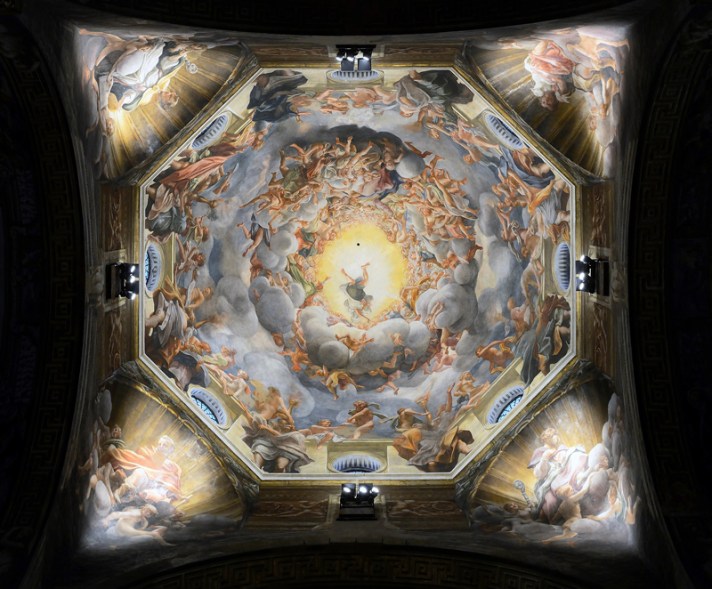
Correggio, 1489?-1534. Assumption – Christ, Mary, Saints, and Angels in Glory, from Art in the Christian Tradition, a project of the Vanderbilt Divinity Library, Nashville, TN. https://diglib.library.vanderbilt.edu/act-imagelink.pl?RC=55579 [retrieved November 7, 2023]. Original source: https://commons.wikimedia.org/wiki/File:Cathedral_(Parma)_-_Assumption_by_Correggio.jpg.
RCL Year A, All Saints
Revelation 7:9-17, Psalm 34:1-10 and 22, I John 3:1-3, Saint Matthew 5:1-12
Nothing pleases me more than preaching and celebrating the Eucharist of All Saints. Episcopalians love this Feast, not because we are free to celebrate it on the day itself, November 1, as well as the Sunday following; and not because the Feast began in the British Isles before its popularity carried it to Europe. We love it because All Saints affirms all Christians.
We have a strong suspicion that all the saints are not confined to the Bible, nor are all the saints depicted in stained glass. All the saints include people who walk among us, who have touched our lives, as well as those who have gone before us. The Epistle today reminds us, “See what love the Father has given us, that we should be called children of God; and that is what we are.”[1] We are children of God, because we are made in God’s image and are able to glorify God by humbly saying Gloria Patri or by helping someone to cross the street—as we sing in the great hymn, “for the saints of God are just folk like me, and I mean to be one too.”[2]
One of the saints who crossed my path earned the nickname Dead Body by moving so slowly and so deliberately unless, my father told me, he were at the top of the key, faking right or left, before driving to the basket or draining a left-handed or right-handed hook shot. He became a teacher, and one day, before class, he asked, “Mr. Stringfellow, in basketball, how do you aim your shot?” “At the basket,” I said. He recovered quickly and went on. “Mr. Wilson, in basketball, how do you aim your shot?” Mr. Wilson and several others disappointed him too. And Dead Body said, “In basketball, you aim in front of the back of the rim, in back of the front of the rim, to the right of the left of the rim, and to the left of the right of the rim.”
I believe he was talking about more that basketball. He was talking about living and how to live. The bull’s eye he spoke about has a likeness, a comparison, in the spiritual life. We spoke of it in today’s Collect.[3] The bull’s eye is following the saints in virtuous and godly living. We do what they did: we intend to glorify God in whatever we do; we suffer, when we must, and then we do; we press on; and, at the last, we come to those ineffable joys that God has prepared for us. We are faithful to the image of God implanted in us, and we follow it home; that fidelity brings us to our intended destination—the presence of God in all his glory.
In the words of Saint John the Divine: [We] will hunger no more, and thirst no more; the sun will not strike [us], nor any scorching heat; for the Lamb at the center of the throne will be [our] shepherd, and he will guide [us] to springs of the water of life, and God will wipe away every tear from [our] eyes.”[4]
[1] I John 3:1.
[2] Hymn 293, Stanza 3.
[3] The BCP, page 245.
[4] Revelation 7:16-17.
 hs3rd
hs3rd 
_-_Assumption_by_Correggio.jpg)