
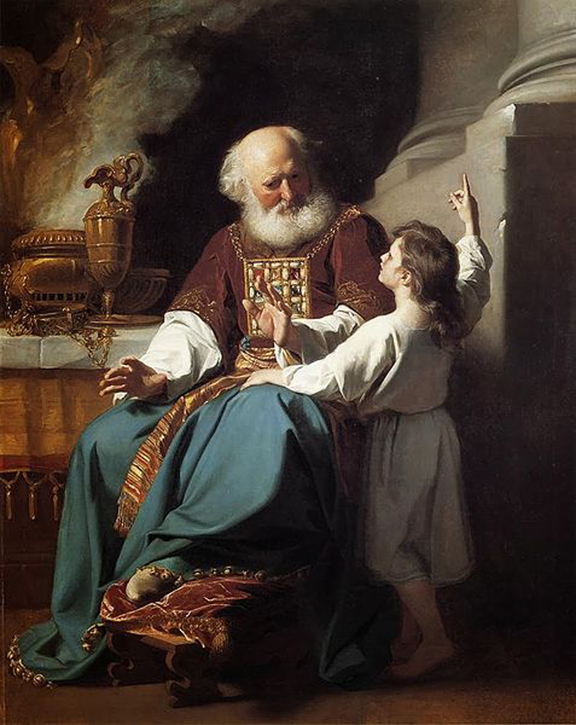
Copley, John Singleton, 1738-1815. Samuel Relating to Eli the Judgments of God upon Eli’s House, from Art in the Christian Tradition, a project of the Vanderbilt Divinity Library, Nashville, TN. https://diglib.library.vanderbilt.edu/act-imagelink.pl?RC=56458 [retrieved January 17, 2024]. Original source: https://commons.m.wikimedia.org/wiki/File:Eli_and_Samuel.jpg.
RCL Year B, Epiphany 2
1 Samuel 3:1-20; Psalm 139:1-5 and 12-17; 1 Corinthians 6:12-20; Saint John 1:43-51
The calling of Samuel and the calling of Philip and Nathanael make clear several things about our lives as creatures and servants of the Living God.
In both Readings, God is physically close and intimately involved with his creatures and servants. Samuel lies down in the temple of the Lord, “where the ark of God was.”[1] The ark is the ark of the covenant, the chest containing the tablets of stone on which were inscribed the ten commandments. These tablets were the very ones Moses received from the Lord on Mount Sinai. The lid of the chest displayed two sculptures of two cherubim or angels. And that lid was known as the mercy seat. Just above the mercy seat was the place where the Lord lived. No one was physically closer to the Lord than Samuel, but the Reading tells us how Samuel came to know the Lord. At first, Samuel thinks Eli calls him. But Eli teaches Samuel that it is the Lord who calls him, and the Lord teaches Samuel that he is about to punish Eli’s house or descendants forever for the wickedness of his sons and Eli’s failure to restrain them. The Lord calls Samuel to replace Eli, to become his priest and judge over Israel until Israel prefers to follow a king in place of the Lord. It is fair to say that the Lord disclosed to Samuel the meaning of his life.
Jesus finds Philip and says to him, “Follow me.” Just a few verses earlier, John has described Jesus as the Word, who was with God and was God, who made all things.[2] In the first verses of the Letter to the Hebrews, we read that Jesus “is the reflection of God’s glory and the exact imprint of God’s very being, and he sustains all things by his powerful word.”[3] Jesus is right there beside him, as close to him as the Lord was to Samuel. Jesus impresses Philip, so that Philip answers Jesus’ call. And Philip goes on to find Nathanael and to tell him that he has “found him about whom Moses in the law and the prophets wrote.”[4] The creator of Philip and Nathanael knows them intimately, and they respond to him, because he knows them, he is the Word of their lives, and he is the purpose of their lives. It is fair to say that Philip and Nathanael become aware that Jesus is the purpose of their lives. Nathanael exclaims, “Rabbi, you are the Son of God! You are the King of Israel!”[5]
In hearing God’s call and in responding, you and I discover the meaning of our lives. We grow as we hear and answer God’s call. When we do not hear God’s call or when we do not respond, we do not grow. We do not grow as individual persons or as a parish.
The minute that you or I begin not to hear God’s call becomes the very minute that you or I begin to allow something to block our relationship with God. And then our relationship with God and with each other withers. Imagine Philip hearing the voice of Jesus saying “Follow me,” and imagine Philip not responding. Imagine what and who he would then be. Imagine the damage that would be done.
For God has not created us, God has not baptized us, into his Son’s death and resurrection, to seek our own will or our own pleasure. God has created us, God has baptized us, to be his people, to be in a relationship with him which is loving and tender. God has done this for us so that we may be his people in a broken world, a world broken by things not true, a broken world desperate to be healed and forgiven.
The call from God is here. God always calls on us to follow him. The ministry to a broken world and broken people is right here, not far away at all. More than one, surely, will say with Samuel in the Old Testament Lesson, “Speak, for your servant is listening.”[6]
[1] I Samuel 3:3.
[2] Saint John 1:1-3.
[3] Hebrews 1:2-3.
[4] Saint John 1:45.
[5] Saint John 1:49.
[6] 1 Samuel 3:10.
 hs3rd
hs3rd 
