
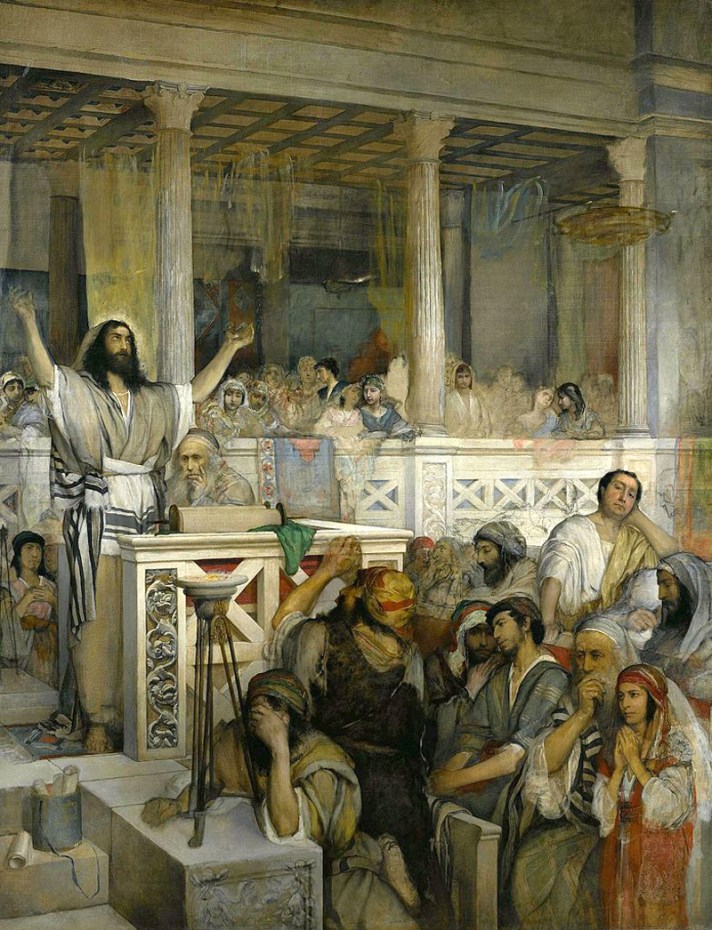
Gottlieb, Maurycy, 1856-1879. Christ Preaching at Capernaum, from Art in the Christian Tradition, a project of the Vanderbilt Divinity Library, Nashville, TN. https://diglib.library.vanderbilt.edu/act-imagelink.pl?RC=56399 [retrieved January 28, 2024]. Original source: https://commons.wikimedia.org/wiki/File:Maurycy_Gottlieb_-_Christ_preaching_at_Capernaum_-_Google_Art_Project.jpg.
RCL Year B, Epiphany 4
Deuteronomy 18:15-20; Psalm 111; 1 Corinthians 8:1-13; Saint Mark 1:21-28
The Gospel today begins after only twenty verses of Saint Mark: we are at the very beginning of Jesus’ public ministry. Prior to today, we have heard the preaching of John the Baptist. Jesus has been baptized by John, though we missed that because of snow, and he has been tempted by Satan, and last Sunday we heard Jesus preaching the kingdom, calling for repentance, and calling Simon and Andrew, James and John, to follow him.
Today we see him teaching in the synagogue at Capernaum and curing a demoniac, who recognizes Jesus, “I know who you are, the Holy One of God.”[1] Witnessing his teaching and the cure, the people in the synagogue are amazed, “What is this? A new teaching—with authority! He commands even the unclean spirits, and they obey him.” [2] And his fame spreads, as you may well imagine.
A lot is going on here, much of it beneath direct observation. And I would describe it this way. As he begins his public ministry Jesus walks into and fulfills one of the important Messianic prophecies. Conveniently, the Lectionary has given us that prophecy in today’s reading from Deuteronomy.
There, the children of Israel fear that if God speaks to them directly or if they see again the great fire, representing God, that they will die. Moses, the prophet, stands between them and God, and they do not want to lose him. They ask that there be such a prophet always to speak for God and to guide them. Moses, the prophet, the intermediary between them and God, reports to them that God said to him, “I will raise up for them a prophet like you from among their own people; I will put my words in the mouth of the prophet, who shall speak to them everything that I command.”[3]
Moses seems to be referring to all the true prophets who were to succeed him. And Christ, teaching with authority in the synagogue in Capernaum and healing the demoniac, fulfills the expectation Moses sets for all those prophets. He fulfills and completes the prophetic office. The passage from Deuteronomy was understood in a special Messianic sense by both the Jews and the Apostles.
The Gospel today proclaims Jesus to be the intermediary between us and God. We can approach God, we can draw near to God, and we can be in a relationship with God by being in a relationship with Jesus. God sent Jesus to us to bridge the gap, to make it possible for us to be in a relationship with him. These things are beginning to dawn upon the people as they observe Jesus at the very beginning of his public ministry.
There is a simple and very concrete illustration of Jesus’ position mediating God to us and us to God. Have a look at the Collect of the Day in your service leaflet.[4]
We address God, “Almighty and everlasting God.” We acknowledge God to “govern all things in heaven and earth.” And we ask that God, “Mercifully hear the supplications of your people, and in our time grant us your peace.” And all these things we ask “through Jesus Christ our Lord.” Jesus is the avenue to God. Jesus makes it possible for us to approach God. And through his ministry to us, we remain in relationship with God our Father.
In that synagogue in Capernaum, at the very beginning of his ministry, Jesus begin to do all these things on our behalf. He has begun to do for us what we cannot do for ourselves.
[1] Saint Mark 1:24.
[2] Saint Mark 1:27.
[3] Deuteronomy 18:18.
[4] The BCP, Epiphany 4, page 215.
 hs3rd
hs3rd 
