
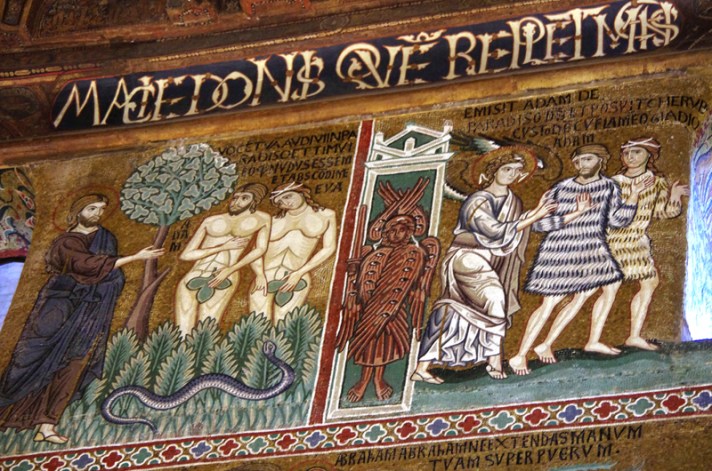
God Calls Adam and Eve to Account for their Sin, from Art in the Christian Tradition, a project of the Vanderbilt Divinity Library, Nashville, TN. https://diglib.library.vanderbilt.edu/act-imagelink.pl?RC=58564 [retrieved June 10, 2024]. Original source: https://www.flickr.com/photos/snappa2006/8154617549.
RCL Year B, Proper 5 (Alternate Readings)
Genesis 3:8-15, Psalm 130, 2 Corinthians 4:13–5:1, Saint Mark 3:20-35
We continue today our new concentration on Jesus’ ministry, his being “an example of godly life.”[1] We are marching through Mark, addressing that Gospel’s presentation of Jesus’ ministry and teaching.
Today’s portion of Saint Mark is remarkably complex, and I would not fairly be your preacher without placing some of that complexity before you.
Mark unites two traditions about Jesus, two traditions that Matthew and Luke leave aside, and you can see these traditions in the Gospel today. One tradition is that his teaching is so radical that his own family and relatives reject him. The other tradition is that he is a sorcerer and possessed by a demon. You could easily take a highlighter and mark these ideas in today’s Gospel.
Even so, let’s begin with the reading from the Old Testament. There we see the Lord God casting out of the society of Adam and Eve the serpent, the figure for Satan. And in the Gospel Jesus defends himself of being possessed by a demon by asking rhetorically, “How can Satan cast out Satan?”[2] Earlier in Mark, Jesus cured a demoniac, mirroring what his Father did in Eden and triggering the charge of being possessed himself.
Saint Mark, I believe, resolves the two traditions I mentioned by identifying Jesus with the Lord God in Genesis and with the one who plunders the strong man’s house in the Gospel today. The point of these identifications is that Jesus plunders Satan’s house, robbing him of his followers, through his ministry and teaching. And, Jesus drives out demons, just as his Father drove the serpent out of Eden.
Additionally, Jesus’ ministry and teaching constitutes a new family, a family of people who do not share each other’s blood, but who share Jesus’ blood shed on the cross. This new family resembles Jesus in its willingness to accept rejection and even suffering if they be God’s will.
The acceptance of rejection and suffering is something that Peter will learn when he rejects Jesus by denying him. Peter has to learn this lesson, and I believe that you and I as followers of Jesus have to learn it also.
I will go further. I think learning this lesson, learning to accept rejection and suffering as the inevitable consequences of following Jesus, is the way we become authentic followers of Jesus. So long as we keep ourselves happy, well-fed, and free from obedience and responsibility to Jesus, we have not learned the lesson. But when we take his ministry and teaching to heart to the extent of performing his will in this world, we inevitably trigger a response requiring us to learn the lesson.
For indeed, obedience and responsibility to Jesus are what lie ahead for each of us. We are spiritually naïve if we do not see this. For we know from attending baptisms that we are baptized into Jesus’ suffering and death as well as his resurrection.[3] It’s simply true that we shall not have one without the other. If we have his resurrection, we have his suffering and death. If we have his suffering and death, we have his resurrection. Not ours, but another church has a hymn, “‘Are ye able,’ said the Master, ‘to be crucified with me.’”[4] It’s a question we all face, and our answer defines us as Christ’s own for ever if we truthfully reply with Yes. Did we not hear, in the Epistle, “For we know that if the earthly tent we live in is destroyed, we have a building from God, a house not made with hands, eternal in the heavens”[5]?
[1] The BCP, page 232.
[2] Saint Mark 3:23.
[3] BCP, page 306.
[4] The United Methodist Hymnal, Hymn 530.
[5] 2 Corinthians 5:1.
 hs3rd
hs3rd 