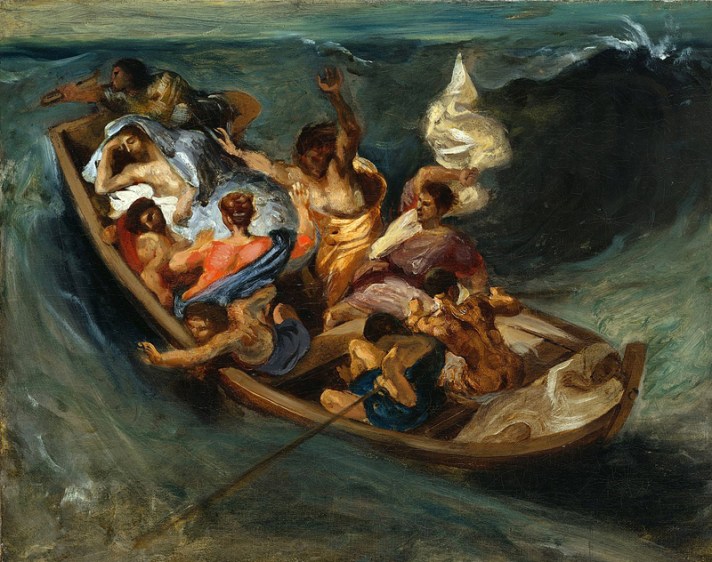
Delacroix, Eugène, 1798-1863. Christ on the Sea of Galilee, from Art in the Christian Tradition, a project of the Vanderbilt Divinity Library, Nashville, TN. https://diglib.library.vanderbilt.edu/act-imagelink.pl?RC=56575 [retrieved June 23, 2024]. Original source: https://commons.wikimedia.org/wiki/File:Eug%C3%A8ne_Delacroix_-_Christ_on_the_Sea_of_Galilee_-_Google_Art_Project.jpg.
RCL Year B, Proper 7 (Alternate Readings)
Job 38:1-11, Psalm 107:1-3 and 23-32, 2 Corinthians 6:1-13, Saint Mark 4:35-41
As a pastoral observation, I recognize that on the seventh day of a heat wave, that we are all weary of the heat and want to move on to cooler and pleasanter temperatures. This is not a favorable circumstance in which to deliver a long and boring sermon.
So, I have prepared a short and pointed homily that cuts to the bone immediately if not sooner.
Much of our understandable and human concern boils down to this: either God made the world and all that therein is, or, on the other hand, the world and all that therein is came into being somehow but of its own accord.
We have in the Gospel today a boat nearly full of understandable and human concern. “Teacher, do you not care that we are perishing?”[1] Let’s think about perishing for a second or two. So long as the disciples can utter the word perishing, they have not perished. In fact, the opposite is true. They are being saved. About some things, the disciples simply aren’t reliable. On that boat in the Sea of Galilee, there is no observational evidence that they are perishing. Alongside that lack of evidence there is direct evidence that they are being saved even as they utter the word perishing.
I have belabored this point to move along swiftly to another one. Observational evidence, a requirement in the natural and physical sciences, indicates that the world and all that therein is has a cause that cannot be detected observationally.
The cause that cannot be detected observationally opens the door to God, who declares in the rhetorical question put to Job, “Where were you when I laid the foundation of the earth?”[2]
Still full of understandable and human concern, if not swirling and self-defeating anxiety, the disciples end the Gospel with the question, a question that is a step in the right direction, “Who then is this, that even the wind and the sea obey him?”[3]
I cannot speak for anyone but me. If the choice is between those who claim to be perishing when they are not, and the fellow asleep on the cushion, I’ll take the fellow asleep on the cushion.
[1] Saint Mark 4:38.
[2] Job 38:4.
[3] Saint Mark 4:41.
 hs3rd
hs3rd 
