
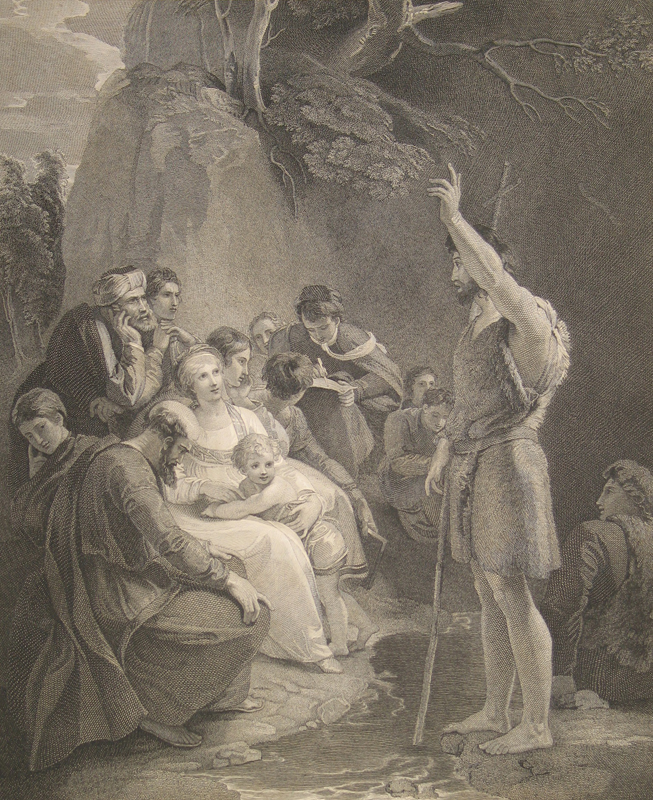
Stothard, Thomas, 1755-1834; Skelton, William, 1763-1848. The Macklin Bible — John Preaching in the Wilderness, from Art in the Christian Tradition, a project of the Vanderbilt Divinity Library, Nashville, TN. https://diglib.library.vanderbilt.edu/act-imagelink.pl?RC=54080 [retrieved December 23, 2023].
RCL Year B, Advent 3
Isaiah 61:1-4 and 8-11, Psalm 126, I Thessalonians 5:16-24, Saint John 1:6-8 and 19-28
The Second and Third Sundays of Advent present John the Baptist to us, and today I want to suggest to you that John represents the Law and the Prophets. When John points to Jesus, we should understand that in reality the Law and the Prophets point to Jesus. This is how Jesus and the Gospel writers saw John.
John the Baptist preached to great crowds about preparing for the kingdom of God and for the coming of the Messiah. And we draw from that preaching that repentance remains as the necessary condition for anyone who wishes to enter and to be a part of the kingdom of God. And we need to understand repentance in the sense used by John and Jesus in the Gospels. It means a transformation of the heart and mind, a reorientation of our whole way of thinking, feeling, and perceiving, a change from self-centeredness to God-centeredness. John’s message of repentance means that we overthrow the kingdoms of self-will to enter the Kingdom of God.
If we are honest, we will admit that self-will has very largely been the vehicle we have driven to arrive where we are. We resist, more than anything else, the loss of control.
But the Gospel is the Good News that overthrows the conventional wisdom of the world. He who would save his life, says Christ, will lose it, and yet he who loses his life for Christ’s sake will find it. Very near at hand is an astonishing grace and freedom to define oneself as Christ’s own possession, to give ourselves over to him. In a similar way, in a similar sacrifice, Christ himself makes himself our food in this Eucharist and simultaneously invites us to live in the same way.
The proper way to celebrate Jesus’ birth is to recognize and appreciate him for who he is. We cannot do that if we are locked in self-centeredness. The example he gives us is being the baby in the manger who becomes the man on the cross, because Almighty God united himself to our nature to redeem us from sin and death.
The Law and the Prophets, and John the Baptist, point to this transformation from self-centeredness to God-centeredness. It’s a transformation we are free to make, using the grace and power which God bestows upon us. It is no stretch to imagine that God gave us this grace and this power for just this reason—that we may become his children and his agents in a world swimming in the same self-centeredness that we decide to leave behind.
I commend John the Baptist to you. He sums the Law and the Prophets and points to the Redeemer of the nations. His humility mixed with his stern prophecy pave the way for us to choose to be Christ’s own possession, giving ourselves to others as he gives himself to us.
 hs3rd
hs3rd 
You must be logged in to post a comment.