
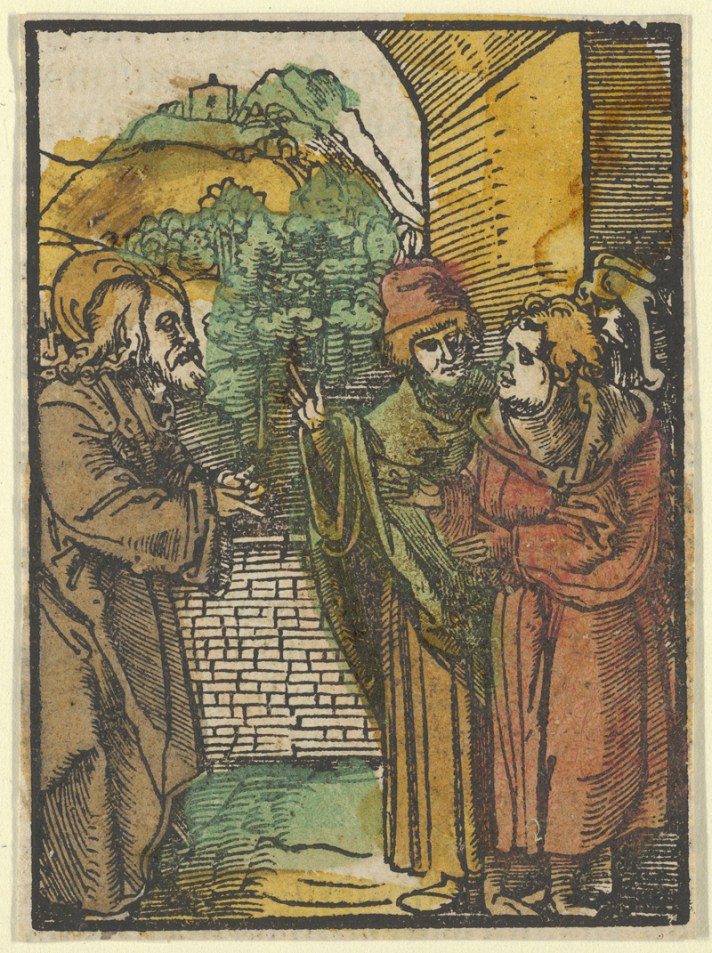
Schäufelein, Hans, approximately 1480-approximately 1539. Christ and the Pharisees, from Art in the Christian Tradition, a project of the Vanderbilt Divinity Library, Nashville, TN. https://diglib.library.vanderbilt.edu/act-imagelink.pl?RC=56831 [retrieved October 29, 2023]. Original source: https://commons.m.wikimedia.org/wiki/File:Christ_and_the_Pharisees,_from_Das_Plenarium_MET_DP849932.jpg.
RCL Year A, Proper 25 (Alternate Readings)
Leviticus 19:1-2 and 15-18, Psalm 1, I Thessalonians 2:1-8, Saint Matthew 22:34-46
Happy are they whose delight is in the law of the Lord.[1]
The Pharisees return to Jesus in the Gospel today, and their encounter with him is most instructive, particularly under the heading of what could have been and how what could have been differs from what happens.
The Pharisees bring one of their number who is a lawyer. Certainly, a lawyer knows the law better than this carpenter. Certainly, he will outsmart Jesus. This week, my ears picked up when Alan Dershowitz, the Harvard Law School professor emeritus, in a podcast, referred to the first five books of the Bible, the Torah, as a “lawbook.”[2] Certainly, the Books of Moses were a “lawbook” to the Pharisees and to Jesus as well. The lawyer asks Jesus which law, which commandment, is the greatest, and Jesus answers with a portion of the shema from Deuteronomy 6, which requires the love of God. He says it is the first and greatest commandment, and he goes on to give the second greatest commandment, requiring the love of neighbor, from Leviticus 19, today’s First Lesson.
At this point, Jesus, the lawyer, and the Pharisees remarkably share agreement. They are on the same page. They read the Law of Moses identically. There is no variance or disagreement among them. But then Jesus asks the Pharisees a question. Two can play this game. “What do you think of the Messiah? Whose son is he?”[3]
The word Messiah is derived from a Hebrew word, and it means anointed. Samuel anointed David king over Israel. David’s descendants were anointed kings over Israel. And so, the Pharisees respond that the Messiah is the “son of David.”[4] But a new Messiah has just asked the question. He has been anointed to be the Savior and Redeemer of the world. What would have happened if they had answered the question differently? What would have happened if the Pharisees had seen and understood what others had seen and understood? What if they had said, “The Messiah is the Son of the true and living God”?
I have made this point to remind you of something important. Whenever Jesus asks you a question, at least one answer always leads to salvation and redemption. He carries salvation and redemption around with him all the time. He came to give them away. He came to give them to you and to me.
As it is, he responds to the Pharisees by showing them who he is: he quotes Psalm 110, verse 1, “The Lord said to my Lord, ‘Sit at my right hand, until I put your enemies under your feet.’” By this quotation, Jesus declares to the Pharisees that the Lord is the one who says to the anointed king, “Take your place at my right hand while I put your enemies under your feet.” The Messiah is the one who saves us from all our enemies. None of David’s descendants was able to do that until this descendant, until this descendant came and dispelled all the Pharisees’ riddles, all their questions, all their plots, and every attempt they made to whittle him down to size. The salvation and redemption he carries around was for the Pharisees, too. They were among the ones he came to claim as his own—if only they could have claimed him.
[1] Refrain for Psalm 1.
[2] Alan Dershowitz, The Dershow, “A Brief History of the Wars against Israel,” 23 October 2023.
[3] Saint Matthew 22:42.
[4] Ibid.
 hs3rd
hs3rd 

You must be logged in to post a comment.