
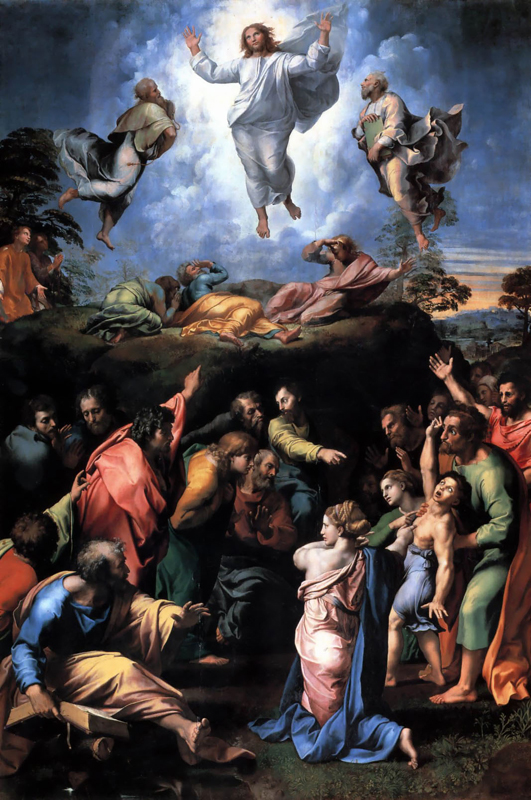
Raphael, 1483-1520 ; Romano, Giulio, 1499-1546. Transfiguration, from Art in the Christian Tradition, a project of the Vanderbilt Divinity Library, Nashville, TN. https://diglib.library.vanderbilt.edu/act-imagelink.pl?RC=54165 [retrieved August 6, 2023]. Original source: https://commons.wikimedia.org/wiki/File:Transfiguration_Raphael.jpg.
RCL, The Transfiguration of Our Lord Jesus Christ
Exodus 34:29-35, Psalm 99, II Peter 1:13-21, Saint Luke 9:28-36
Only a handful of Feasts can bump any other day or observance. They are Christmas Day, The Epiphany, The Holy Name, The Presentation, today’s Feast, The Transfiguration of Our Lord Jesus Christ, and All Saints Day. When any one of these Feasts falls on a Sunday, it is to be celebrated in place of the Eucharist scheduled for that Sunday. Each of them falls on a Sunday about once every six years. The last time the Transfiguration fell on a Sunday was in 2017. The next year it falls on a Sunday is 2028. All this information is to be found in the Prayer Book. [1]
The calendrical angle fascinates me, but there is much more. All three Synoptic Gospels record the Transfiguration and present it as an historic event. You probably have observed that the Transfiguration is the Gospel each year on the Last Sunday after the Epiphany which is the Sunday before Ash Wednesday.
But when we have the opportunity to celebrate the Feast on its day, as we are blessed to do today, some important things claim our attention and demand to be noticed.
First, as Jesus is transfigured alongside Moses and Elijah, the veil of Jesus’ humanity which conceals his divinity, like a curtain, is pulled aside revealing his divinity, on display for Peter, John, and James to witness. They witness his glory; that is, they see it for themselves, and they tell others about it, as Peter does in his Epistle when he declares that they are “eyewitnesses of [Jesus’] majesty.”[2]
And, the event declares the testimony of the Law, figured in Moses, and the Prophets, figured in Elijah, to the Messiahship of Christ. As they talk with Christ, the Law and the Prophets become part of Christ, and his divinity underscores and emphasizes their connection to the Word of God. And we see also the connection between the Word of God and God the Father. As we read in Second Corinthians, for it is God who said, “‘Let light shine out of darkness,’ who has shone in our hearts to give the light of the knowledge of the glory of God in the face of Jesus Christ.”[3] This passage is a source of the Preface of the Eucharist today.
Finally, the Transfiguration transitions to the Passion. Soon after the Transfiguration, Jesus predicts for the second time that the “Son of Man is going to be betrayed into human hands.”[4] And, just fifteen verses after it, Jesus sets “his face to go to Jerusalem,”[5] for the final attack upon his humanity where that humanity will be sacrificed to glorify his divinity as he becomes the Savior and Redeemer of the world.
When we celebrate the Transfiguration, we offer ourselves to his service, so that our lives may by his be ransomed, healed, and forgiven, so that we, in the words of the Collect, may be “delivered from the disquietude of this world,”[6] and our feet may be set upon the path to follow him from glory to glory, world without end.
[1] The BCP, pages 15-16, 26, and 880-881.
[2] II Peter 1:16.
[3] II Corinthians 4:6.
[4] Saint Luke 9:44.
[5] Saint Luke 9:51.
[6] The BCP, page 243.
 hs3rd
hs3rd 

You must be logged in to post a comment.