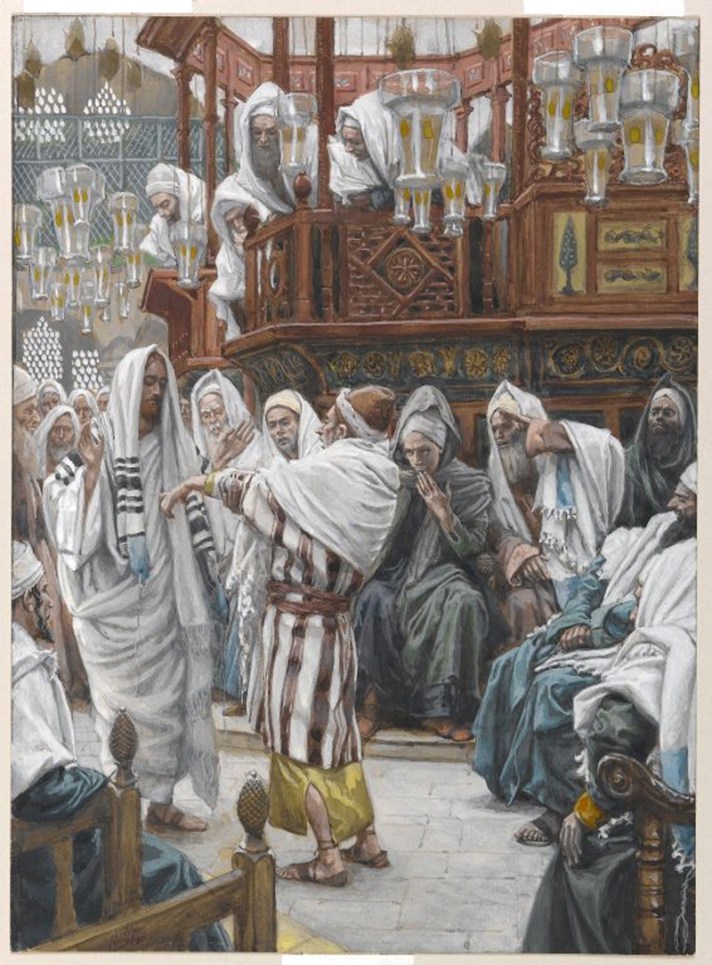
Tissot, James, 1836-1902. Man with the Withered Hand, from Art in the Christian Tradition, a project of the Vanderbilt Divinity Library, Nashville, TN. https://diglib.library.vanderbilt.edu/act-imagelink.pl?RC=57938 [retrieved June 3, 2024]. Original source: https://commons.wikimedia.org/wiki/File:Brooklyn_Museum_-_The_Man_with_the_Withered_Hand_(L%27homme_%C3%A0_la_main_dess%C3%A9ch%C3%A9e)_-_James_Tissot_-_overall.jpg.
RCL Year B, Proper 4 (Alternate Readings)
Deuteronomy 5:12-15, Psalm 81:1-10, II Corinthians 4:5-12, Saint Mark 2:23—3:6
Today marks the turning point of the Church Year. To amplify the turning point, I ask you to open your Prayer Books to page 232 and have a look at the Collect for Proper 15, the Sunday closest to August 17.
There we see Jesus Christ described two ways. He is “a sacrifice for sin, and also an example of godly life.”[1] The part of the Church Year we have just left behind, from Advent through Trinity Sunday, concentrates on Jesus as a “sacrifice for sin.” From preparing for his birth in Advent to his glorification, his Ascension into heaven, and the gift of the Holy Spirit, we have focused on his atoning sacrifice. Now, from today to the First Sunday of Advent, December 1, the long Green Season, we focus on him as “an example of godly life,” his teachings and at times his corrections of the religion of his forebears. Both aspects of his ministry are important, as we read in the petition, or request, in the Collect: “Give us grace to receive thankfully the fruits of his redeeming work, and to follow daily in the blessed steps of his most holy life.”[2] Both aspects of his ministry are important, and we are to appropriate both of them in our lives.
During the long Green Season, we will be following the readings known as Track Two Readings. They are the readings where the Old Testament readings are thematically related to the Gospel readings. Today is an excellent example of an Old Testament reading and a Gospel that are thematically related.
Today, we have an Old Testament reading and a Gospel about the Sabbath Day itself and about keeping the Sabbath Day holy.
We have the old Sabbath and the new Sabbath. Deuteronomy gives us the old: “the seventh day is a sabbath to the Lord your God; you shall not do any work.”[3] This is the Sabbath the Pharisees have in mind when they reproach Jesus as his disciples pluck heads of grain and as Jesus himself restores a man’s withered hand.
Jesus tells them, “The sabbath was made for humankind, and not humankind for the sabbath.”[4] Thus Jesus inaugurates a new sabbath, a sabbath marked by the priority of human need over religious observance. The disciples need the heads of grain for food, and the man with the withered hand needs two hands.
This new meaning shows God’s love for all of humankind, and God’s intention to provide what humankind needs. We rightly remember the sabbath by remembering this: that God himself worked on the new sabbath, the first day of the week, when Jesus rose from the dead. Every sabbath, every first day of the week reminds us of God’s gift of his Son to us and how in him we have hope “to live with confidence in newness and fullness of life, and to await the coming of Christ in glory, and the completion of God’s purpose for the world.”[5]
May each of us remember always, and especially on Sundays, that God has done for us what we could never do for ourselves. “I am the Lord your God, who brought you out of the land of Egypt and said, * ‘Open your mouth wide, and I will fill it.’”[6]
[1] The BCP (1979), page 232.
[2] Ibid.
[3] Deuteronomy 5:14.
[4] Saint Mark 2:27.
[5] The Book of Common Prayer, page 861.
[6] Psalm 81:10.
 hs3rd
hs3rd 
_-_James_Tissot_-_overall.jpg)
You must be logged in to post a comment.