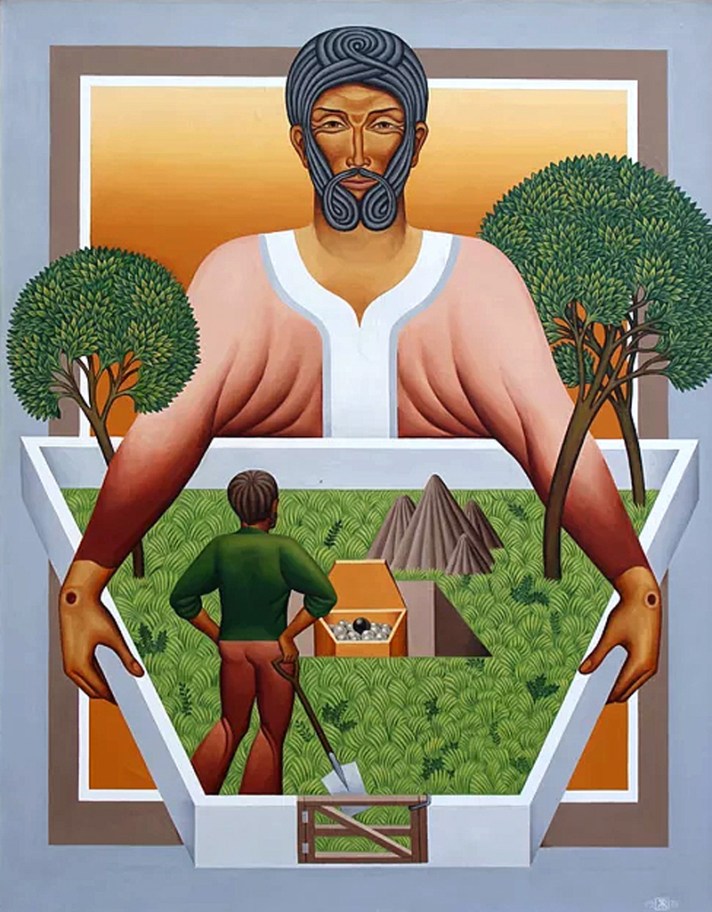
Koenig, Peter. Treasure in the Field, from Art in the Christian Tradition, a project of the Vanderbilt Divinity Library, Nashville, TN. https://diglib.library.vanderbilt.edu/act-imagelink.pl?RC=58507 [retrieved July 31, 2023]. Original source: Peter Winfried (Canisius) Koenig, https://www.pwkoenig.co.uk/.
RCL Year A, Proper 12 (Alternate Readings)
I Kings 3:5-12, Psalm 119:129-136, Romans 8:26-39, Saint Matthew 13:31-33 and 44-52
I count six parables in the Gospel today. One of them, the Mustard Seed, has parallels in Mark and Luke. The parable of the Leaven has a parallel in Luke. The remaining four are unique to Matthew. They are not found anywhere else in the Gospels.
It is perfectly possible to interpret all six parables and thus to discover each parable’s particular meaning. From those six meanings, a single meaning could possibly be deduced and applied to our lives. But I think Jesus and Matthew are moving in a different direction. All six parables and their separate meanings point toward the large number and range of decisions we all make in the course of a single day, the huge number of decisions we all make in the course of a lifetime.
In the background, we have the lesson from First Kings, which explains how Solomon became so wise. When Solomon asks the Lord to be able “to discern between good and evil”[1], the Lord is pleased and grants Solomon’s request, because Solomon has not asked for long life or riches, or for the life of his enemies.[2] Solomon asks for the ability to “walk in [the Lord’s] ways, keeping [the Lord’s] statutes and commandments.”[3]
The Lectionary lays side-by-side the six parables and Solomon’s request to be able to walk in the Lord’s ways and keep his commandments. The parables disclose the kingdom of God, a “treasure” more valuable than money, a treasure comparable to the wisdom of Solomon which guides him in the ways of the Lord. Following the ways of the Lord describes the life, I think, we all want.
And, that life is mirrored in the Collect when we pray that “with [the Lord] as our ruler and guide, we may so pass through things temporal, that we lose not things eternal.”[4]
There we have it. We want to live through this life in such a way that we lose not the life eternal with Jesus Christ our Lord. We have been given that life through Jesus Christ, and we take that life for our own when we recognize that in hundreds and thousands of decisions, like those made in the six short parables, we stake our claim upon the love shown us by Jesus Christ our Lord. Saint Paul asks, “Who will separate us from the love of Christ?”[5] And you know the answer: neither hardship, nor distress, nor persecution, nor famine, nor nakedness, nor peril, nor sword, will be able to separate us from the love of God in Christ Jesus our Lord.[6]
That life begins with a request like Solomon’s. Does any of us doubt that God will give us our heart’s desire if that desire is to walk in the ways of the Lord? “Steady my footsteps in your word; * let no iniquity have dominion over me.”[7]
[1] I Kings 3:9.
[2] I Kings 3:11.
[3] I Kings 3:14.
[4] The BCP, page 231.
[5] Romans 8:35.
[6] Romans 8:35 and 39.
[7] Psalm 119:133.
 hs3rd
hs3rd 
You must be logged in to post a comment.