
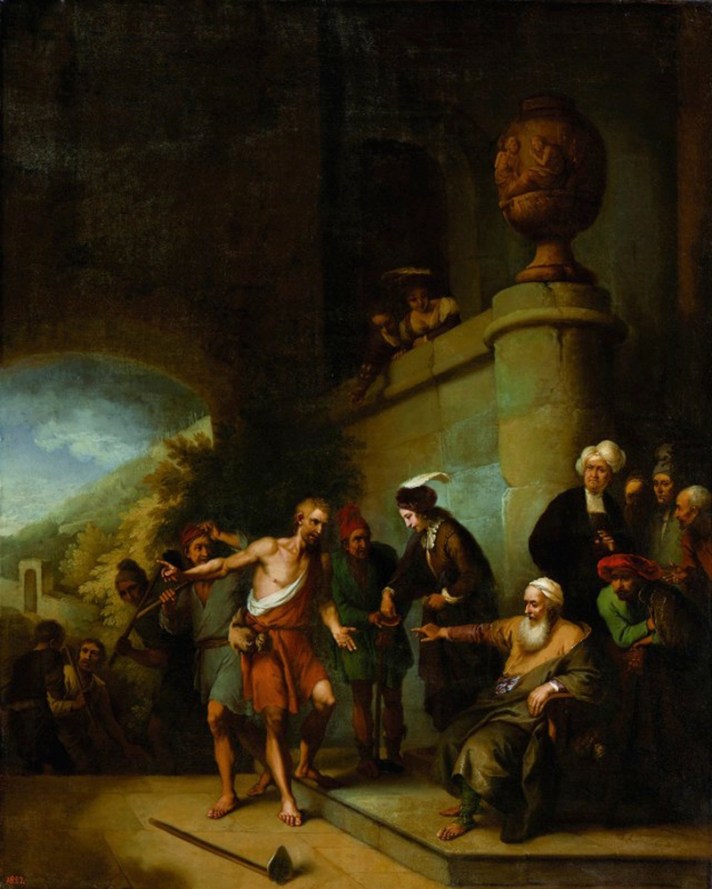
Dietrich, Christian Wilhelm Ernst, 1712-1774. Parable of the Workers in the Vineyard, from Art in the Christian Tradition, a project of the Vanderbilt Divinity Library, Nashville, TN. https://diglib.library.vanderbilt.edu/act-imagelink.pl?RC=57593 [retrieved September 24, 2023]. Original source: https://commons.wikimedia.org/wiki/File:Dietrich_Workers_in_the_vineyard.jpg.
RCL Year A, Proper 20 (Alternate Readings)
Jonah 3:10–4:11, Psalm 145:1-8, Philippians 1:21-30, Saint Matthew 20:1-16
This past week, I have been wondering about Shawn Fain, the President of the striking United Auto Workers Union. What would he make of Jesus’ parable today of the Laborers in the Vineyard? You remember that all the laborers were paid “the usual daily wage.” And, the laborers hired early in the morning and the laborers hired at five o’clock were all paid the same, “the usual daily wage.”
Without taking sides about the strike, for it is not my way to politicize the pulpit, I think it is safe to say that Mr. Fain would not approve of laborers working twelve hours “who have borne the burden of the day and the scorching heat,” to be paid identically as those working one hour in the cooler afternoon. But there it is. With or without the union’s approval, that is what the landowner does. Jesus tells the parable, and he seems to be telling us that in the kingdom, those who are in are completely in, regardless of time served or ability. Isn’t that good news?
I can remember being a sophomore in college, toting my Phillips’ translation of the New Testament most all the time. And I remember being given this parable as the next reading for a Bible Study. Preparing it was a tough study. I had no memory of having encountered the parable before. It contradicted most everything my parents and my headmaster in school had taught me about the world and what to expect from it. They had always taught a fairness that would have rewarded the workers with longer hours. They had never said to me anything like “the last will be first, and the first last.”
So, it was difficult to accept that the landowner who paid all the laborers “the usual daily wage” is a figure in a story representing Jesus or God the Father. But there it was, plain to see but hard to accept. The teaching seems to be that all followers of Jesus are equal in inheriting eternal life.
If we accept that, at the same time we accept something else. We accept that what our parents and headmasters taught us may not include everything there is to know about God. When we enter the kingdom, we enter a mystery that includes what we know and what we do not yet know. We need to be open-minded enough to let God teach us more.
The parable of the Laborers in the Vineyard stretches us. It leads us from what we know to what we have not yet glimpsed. To me, it has become essential to expect that God will do the unexpected, that God’s love and generosity surpass my understanding of love and generosity, and, finally, that in following God we need to be prepared to balance what we know with what we do not know. We live with not only what we can see; we live with what we can only barely glimpse.
And what we know is that God takes the initiative. God created the heavens and the earth, placed us upon the earth with the freedom to serve or to rebel, and provided us with a way back when we rebelled. If you need to do it, see the five o’clock laborers as those who rebelled—those who, like us, sinned and returned to the Lord. See “the usual daily wage” as God’s open arms, welcoming anyone who finds it in his heart to trust in God. See in this parable a loving and merciful God, generous beyond our understanding.
 hs3rd
hs3rd 

You must be logged in to post a comment.