
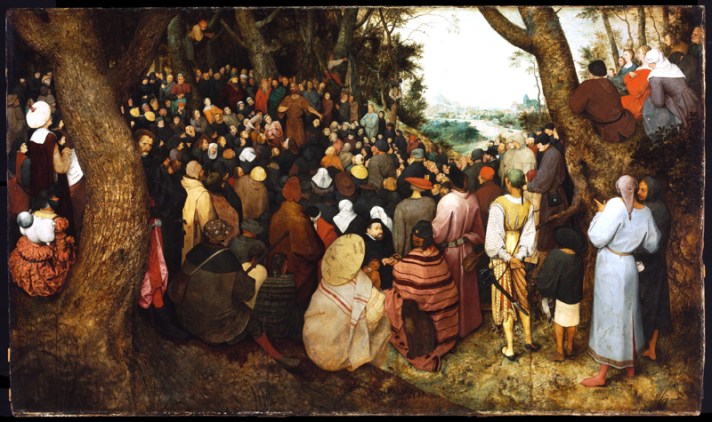
Bruegel, Pieter, 1564-1638. Preaching of Saint John the Baptist, from Art in the Christian Tradition, a project of the Vanderbilt Divinity Library, Nashville, TN. https://diglib.library.vanderbilt.edu/act-imagelink.pl?RC=58375 [retrieved December 10, 2023]. Original source: https://commons.wikimedia.org/wiki/File:Pieter_Bruegel_the_Elder_-_The_Sermon_of_Saint_John_the_Baptist_-_Google_Art_Project.jpg.
RCL Year B, Advent 2
Isaiah 40:1-11, Psalm 85:1-2 and 8-13, II Peter 3:8-15a, Saint Mark 1:1-8
The eight verses of Saint Mark that are the Gospel today thrill me and excite my curiosity. It thrills me that the “good news of Jesus Christ” equates “good news” with “Jesus Christ.”[1] From the very beginning of Mark, likely the first Gospel written, the “good news” is “Jesus Christ,” and “Jesus Christ” is the “good news.”
From the opening fragment—the first verse is not a complete sentence—that equation, that equality, of Jesus Christ and the good news becomes the framework of the Gospel of Saint Mark. Everything in Mark occurs within the equivalence of Jesus Christ and the good news. There is nothing outside that equivalence. There is nothing outside of those boundaries. Mark’s Gospel is a handball or racquetball court where the ball never goes out of bounds. You cannot go beyond that equivalence. It is, and it is all there is. It excites me to be curious about all there is to discover within that equivalence.
As Mark tells his story, we find out some important things along the way. We find out that the action of Mark begins not with Jesus and his birth but with the appearance of John the Baptist. The appearance of John has been predicted by the prophet Isaiah. John is a messenger of God whose legitimacy has been established hundreds of years before.
And we find out, when John begins the story of Jesus, that John proclaims “repentance for the forgiveness of sins.”[2] Within the bounds of the equivalence of Jesus Christ and the good news, lies the good news that our sins can be forgiven and that our sins will be forgiven when we repent. That is good news, and that is Jesus Christ.
We learn also that John appears on the scene to give the stage over to one mightier than he is. That forgiveness of sins comes from that mightier one, Jesus, who will baptize with the Holy Spirit and not with simple and ordinary water.
Reading and meditating on the Gospel of Saint Mark, as we shall do for the next fifty or so Sundays, transport us to the perspective that everything that our senses tell us, everything that we can know, everything that we can experience, and everything we can hope for is God. As Isaiah said to the cities of Judah, “Here is your God!”[3]
[1] Saint Mark 1:1.
[2] Saint Mark 1:4.
[3] Isaiah 40:9.
 hs3rd
hs3rd 
