
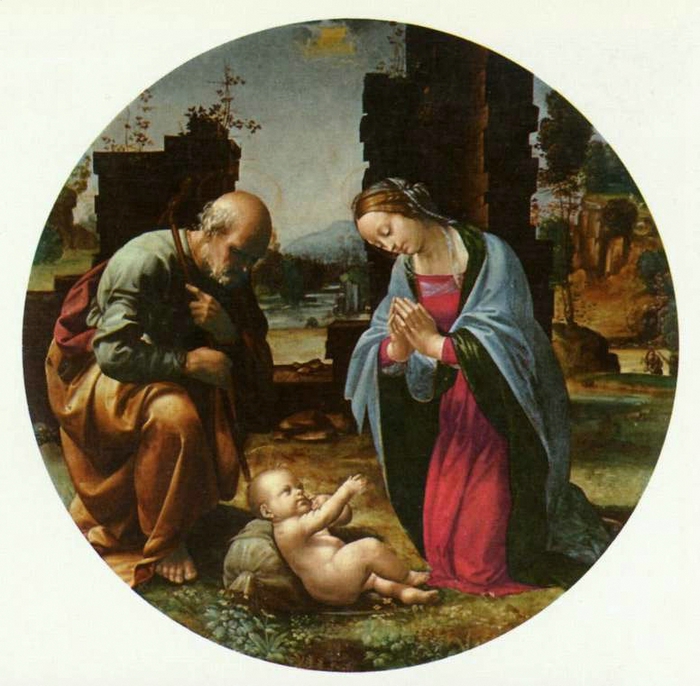
Bartolomeo, fra, 1472-1517. Adoration of the Child, from Art in the Christian Tradition, a project of the Vanderbilt Divinity Library, Nashville, TN. https://diglib.library.vanderbilt.edu/act-imagelink.pl?RC=47872 [retrieved January 1, 2024]. Original source: https://commons.wikimedia.org/wiki/File:Fra_Bartolomeo_001.jpg.
RCL Christmas Proper 2
Isaiah 62:6-12, Psalm 97, Titus 3:4-7, Saint Luke 2:1-20
In order truly to celebrate Christmas, you need to see its connection to Easter.
Hundreds of years before Jesus was born, his life was forecast by the great prophet Isaiah. Tonight’s first lesson is one of the many prophecies of the kingdom and salvation brought by the Baby born in Bethlehem: “‘See, your salvation comes; his reward is with him, and his recompense before him.’ They shall be called, ‘The Holy People, The Redeemed of the Lord’; and you shall be called, ‘Sought Out, A City Not Forsaken.’”[1]
How mysteriously that prophecy has been fulfilled! At the time the child was actually born, perhaps the greatest of all worldly rulers was on his throne, Augustus Caesar. His Roman Empire was, and remains, the wonder of the world, unified by a disciplined army and by roads and aqueducts from one end of the empire to another. Its life was enriched by Greek wisdom and Roman justice, by literature and art and architecture that have been admired and copied ever since. How could any king accomplish more?
The Baby born in Bethlehem was born there because the Emperor ordered a tax census. The family had to leave their Nazareth home for Joseph’s ancestral home. Bethlehem was overcrowded as a result; there was no room at the inn; Jesus was born in a stable. Things got worse. Alert to threats to his rule in Judea arising from Jewish prophecies, King Herod initiated a murderous search for the child. The family fled to Egypt to save the baby’s life.
The beginning of Jesus’ life on earth resembles the end. Questioned at his trial by the Roman governor Pontius Pilate as to whether he was a “king,” Jesus replied, “My kingdom is not from this world.”[2] When his enemies insisted upon his condemnation and death, Pilate had “Jesus of Nazareth, The King of the Jews”[3] as the sign hung on his execution.
What a king he has proved to be! In spite of constant misunderstandings, during his earthly life and since, about the nature of his kingship, he continues to reign and win the allegiance of hearts and minds among every people, race and language on earth. The Roman Empire, and many earthly kingdoms since, have risen and fallen, yet Jesus’ kingdom stands and grows. It is a kingdom of peace, of healing and forgiveness, of revival and new birth, of beauty and inspiration, of grace and goodness and love.
Why do you think you are here on a cold winter’s night? Whatever the superficial reason, the underlying reason is that the Child’s kingdom has in some mysterious way reached and affected you. It isn’t just wonderful music or the dream of a White Christmas. It is the mystery, by which I mean the grace, of our Lord Jesus Christ. That is why we are here. Whatever the state of our faith—strong, growing, tired, burned out, incipient, barely the form of a wish to believe—it is the mystery, the grace, of Jesus, that brings us here. We cannot help being attracted to him, sometimes in spite of ourselves!
Now let me finish by putting something to you. There was no room, not even safety, for Jesus when he was born. Now let us think, what sort of reception does Christ find in me? At Christmas we ask Christ to be “born,” spiritually, in us. Are our souls receptive or even safe places for such a Child? How distracted or selfish or unkind have we allowed ourselves to become? What must we change in order honestly to say, “Come into my heart, Lord Jesus, there is room in my heart for thee”?
[1] Isaiah 62:11b-12.
[2] Saint John 18:36.
[3] Saint John 19:19.
 hs3rd
hs3rd 

You must be logged in to post a comment.