
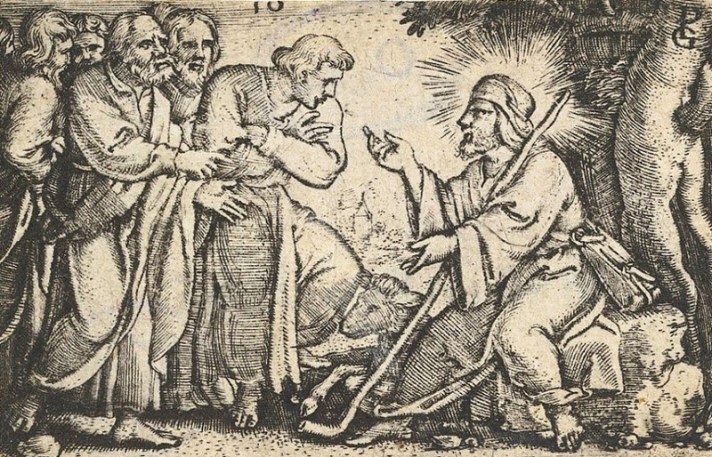
Pencz, Georg. Christ Speaking With the Disciples, from Art in the Christian Tradition, a project of the Vanderbilt Divinity Library, Nashville, TN. https://diglib.library.vanderbilt.edu/act-imagelink.pl?RC=56411 [retrieved June 19, 2023]. Original source: https://commons.wikimedia.org/wiki/File:Christ_Speaking_to_the_Disciples,_from_The_Story_of_Christ_MET_DP855491.jpg.
RCL Year A, Proper 6 (Alternate Readings)
Exodus 19:2-8a, Psalm 100, Romans 5:1-8, Saint Matthew 9:35–10:8
Last Sunday, I thumped on the rules of the road to understand the relationships among the readings on the Sundays after Pentecost. Those relationships obtain again today. The reading from Exodus has themes like those of the Gospel. Psalm 100 comments on Exodus. And Romans continues where it left off last Sunday and has its own themes. And so, three of the four relate to one another while one sits more or less off to the side by itself.
To begin to see how the three relate to one another, let’s begin with Exodus. It ends with, “The people all answered as one: ‘Everything that the Lord has spoken we will do.”[1] And what is it that the people have agreed to do? They have agreed to keep their part of the covenant that God makes with them following their wondrous salvation from slavery in Egypt. In the reading from Exodus, that covenant is described this way by God, “if you obey my voice and keep my covenant, you shall be my treasured possession out of all the peoples.”[2] The unfortunate truth is, however, that the people have not obeyed God’s voice, and they have not kept God’s covenant.
When we see the people of Israel in the Gospel, they are not God’s treasured possession. Saint Matthew comments that when Jesus looks at them, he has compassion for them, “because they were harassed and helpless, like sheep without a shepherd.”[3] They are harassed and helpless precisely because they have not obeyed the voice of God, nor have they kept God’s covenant. They are like sheep without a shepherd because they have abandoned the shepherd. The shepherd has not abandoned them. In fact, a loving and merciful God is giving them another chance, another opportunity to obey his voice and to keep his covenant.
The Christian message, Jesus’ proclamation of the kingdom, is for sheep without a shepherd; the message is for the troubled and those who feel abandoned; it is for tumbleweeds—think of the opening of The Big Lebowski; in other words, it is for everyone. And that message in big strokes is this.
You may feel like a sheep without a shepherd, but you have a shepherd who, perhaps unknown to you, is guiding your path in the direction of home. And not only is that shepherd guiding your path, that shepherd has so created the entire world that the world and everything in it refer to that shepherd. And every longing you may have is in its essence a longing for a relationship with God, who created you to be in a relationship with your Creator.
In broad strokes, that is the Gospel today and that is Jesus’ ministry. You heard in the Gospel today that the crowds had become so large that Jesus delegates much of the responsibility for rounding up the sheep to his apostles. “The harvest is plentiful,”[4] Jesus says, and he sends out laborers into the harvest.
Which means, by the way, not only are your footsteps guided, not only does everything you see refer you to the shepherd, but it means also that shepherd is actively looking for you. That shepherd sends out search parties looking for you.
From now until the end of November, Saint Matthew’s record of the Good Shepherd’s search party will be right before our eyes. And all along the way, our prayer shall be that we “may find and be found by him.”[5]
[1] Exodus 19:8a.
[2] Exodus 19:5.
[3] Saint Matthew 9:36.
[4] Saint Matthew 9:37.
[5] The BCP, page 386.
 hs3rd
hs3rd 

You must be logged in to post a comment.