
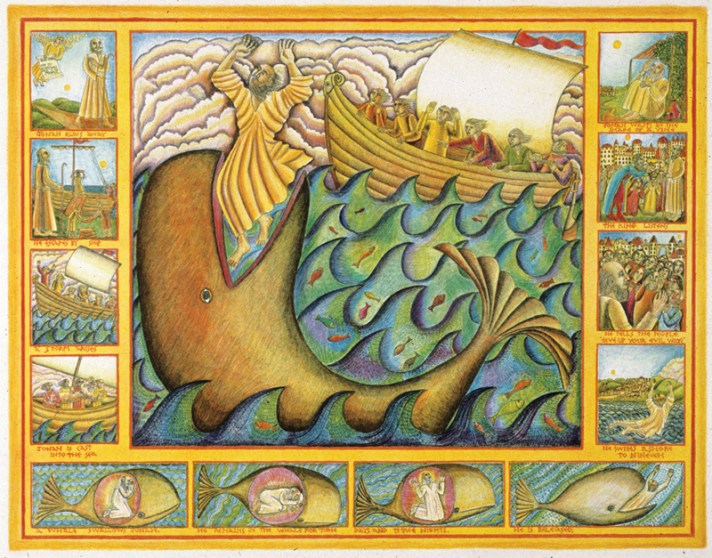
Swanson, John August. Jonah, from Art in the Christian Tradition, a project of the Vanderbilt Divinity Library, Nashville, TN. https://diglib.library.vanderbilt.edu/act-imagelink.pl?RC=56549 [retrieved January 17, 2024]. Original source: Estate of John August Swanson, https://www.johnaugustswanson.com/.
RCL Year B, Epiphany 3
Jonah 2:1-5 and 10, Psalm 62:6-14, I Corinthians 7:29-31, Saint Mark 1:14-20
If you have never done it, I am here today to recommend that sometime soon you pull out the family Bible, make yourself comfortable, adjust your reading lamp, and read the entire book of Jonah. It will take eight or ten minutes.
Jonah was written after the Lord redeemed Israel from the Babylonian captivity. Having been redeemed from slavery in Egypt centuries earlier, and now having been redeemed from deportation to Babylon, Israel had a lot to be proud of. The Lord had now saved Israel from two disasters. Israel was indeed the Lord’s chosen people, for the Lord had proved it twice. Israel had the grounds to gloat. But did Israel overlook something? Did Israel overlook the possibility that the Lord’s loving kindness, his good news, was intended, as the angels sang when Christ was born, for “all the people”[1]?
Jonah certainly overlooked that possibility. The Lord sent Jonah to Nineveh, formerly Babylon, formerly Israel’s captors and oppressors. The Lord sent him to cry against their wickedness, that is, to encourage them to repent.
And what does Jonah do? He goes in the opposite direction. He tries to run away from God. He learns in the belly of a great fish exactly how impossible it is to outrun the Lord. He claims his own redemption from the Lord, and the Lord grants it. And in today’s Lesson, you heard how Nineveh repented and was spared from the just punishment for its wickedness.
Christians have long understood Jonah as an ante-type, or precursor, of Jesus, in that his three days in the belly of a fish parallels Jesus’ three days in the tomb. But, more importantly, Jonah’s preaching of repentance bears fruit, just as Jesus’ preaching of repentance bears fruit. In today’s Gospel, Jesus preaches the kingdom of God, “The time is fulfilled, and the kingdom of God has come near; repent, and believe the good news.”[2] Jesus’ preaching bears fruit immediately. Simon, to be renamed Peter, and Andrew leave their nets and follow him, as do James and John after them.
What else could they do? They could make the serious mistake that Jonah made. They could try to frustrate God by disobedience. And, whether they had read Jonah or not, they may have known exactly how foolish it is to try to accomplish something against God’s will. I put it to you that never has disobedience of God succeeded.
For, God’s will will be done. God permits us to go against his will for a time, but never for very long. God takes the long view, the view that we can never outrun him, the view that we can never put ourselves in a place where he is not near.
All of this is good news, I think. We should take it as good news that God is always to our right and to our left, before us and behind us altogether. We cannot stray beyond his reach. His will, in the end, will be done. And until his will is finally and permanently done, we are free to praise him, we are free to worship him, and we are free to do what he would have us do. For, indeed, we have witness after witness to remind us that his service is our greatest freedom. “In God is my safety and my honor * God is my strong rock and my refuge.”[3]
[1] Saint Luke 2:10.
[2] Saint Mark 1:15.
[3] Psalm 62:8.
 hs3rd
hs3rd 
You must be logged in to post a comment.